Israel will save Israel, and the Gentiles, too

Sermon
Download Sermon
Service
[vimeo 957494262 w=540 h=360]
Download Service Download Bulletin

Sermon for Midweek of Trinity 2

Isaiah 49:1-13

Isaiah 49 begins the middle unit, the second unit of 9 chapters in this last part of Isaiah’s book. And what a beginning it is! This middle unit focuses more on the Messiah than the other two units do, with the famous chapter 53 right in the middle of it all. But this first chapter of Unit 2 begins with an undeniable prophecy about the coming Christ and His work, where He is named Israel, who will be sent to save Israel, and the Gentiles, too.

Listen to me, O coastlands, and give attention, you peoples from afar.

The coming Christ speaks to the coastlands, that is, to the nations in the farthest reaches of the world. This message is to be heard by everyone!

The LORD called me from the womb, from the body of my mother he named my name. He made my mouth like a sharp sword; in the shadow of his hand he hid me; he made me a polished arrow; in his quiver he hid me away.

Now, the Person of the Son of God was with the Father from the beginning. That’s why He’s able to speak right now through the prophet Isaiah, because He already existed. But what He’s prophesying here is what would happen 700 years in the future, at the time of the virgin Mary. When the Lord sent the angel Gabriel to tell Mary that she would conceive and bear a Son, He literally “named the name” of the child who was to be born: Jesus. He speaks of Himself here as an arrow, hidden away in the Father’s quiver, ready to be shot at the devil, and at all the enemies of God.

Then He says something we really have to take note of: And he said to me, “You are my servant, Israel, in whom I will be glorified.” God the Father speaks to the Christ as His servant. That’s nothing new in Isaiah’s prophecy; we’ve seen Israel referred to a few times already as the Servant of the Lord. In the other instances, it could refer to the nation of Israel itself. But not here, as we’ll see in just a moment. Here it refers exclusively to the coming Christ, in whom God the Father would be glorified. As Jesus spoke of His impending crucifixion and death, He said, Now the Son of Man is glorified, and God is glorified in Him. God the Father was glorified in Jesus, because Jesus’ sacrifice on the cross for the sins of the world, together with His resurrection from the dead, showed the grace and goodness of God, His power over sin, death, and the devil, and has caused generations of believers to glorify the name of God for the mercy He has shown us through His Son, our Savior.

But I said, “I have labored in vain; I have spent my strength for nothing and vanity; yet surely my right is with the LORD, and my recompense with my God.”

Here’s a prophecy about how Christ would not be accepted by most in Israel. Yes, for a time, He had multitudes of people following Him. But as you heard in the First Lesson this evening, Jesus spoke the harsh reality to those multitudes: If anyone comes to Me and does not hate his father and mother, wife and children, brothers and sisters, yes, and his own life also, he cannot be My disciple. And many of them began to turn away, so that, by the time Holy Week was over, there were only about 120 believers left in the whole land of Israel. It seemed as if the Messiah had labored in vain.

But He knew it hadn’t been, that it wouldn’t be. He could see past Holy Week, down through the ages as thousands, millions of people would be drawn by the Holy Spirit to believe the word of the Gospel. That future success is what’s depicted in the following verses.

And now the LORD says, he who formed me from the womb to be his servant, to bring Jacob back to him; and that Israel might be gathered to him— for I am honored in the eyes of the LORD, and my God has become my strength—

Now we see it clearly. The nation of Israel is not the true Servant of the Lord. The nation of Israel isn’t the Christ, as modern Jews will sometimes claim. No, we see it clearly stated that Israel, the Servant of the Lord, was being sent to Israel to “bring Jacob,” to “bring Israel back to Him, that Israel might be gathered to Him.” The Christ is the ideal Representative of Israel, who was honored in the eyes of the LORD. As Jesus said, It is My Father who honors Me. He was the Israel who came to save Israel.

But not only Israel! He says: “It is too light a thing that you should be my servant to raise up the tribes of Jacob and to bring back the preserved of Israel; I will make you as a light for the nations, that my salvation may reach to the end of the earth.”

We often cite this verse from Isaiah, because it so clearly prophesies the expansion of the Church of God to include the Gentiles, to include you and me. It’s this verse that Simeon was alluding to when he sang about Jesus as “a Light for enlightening the Gentiles, and for bringing glory to Your people Israel.”

Thus says the LORD, the Redeemer of Israel and his Holy One, to one deeply despised, abhorred by the nation, the servant of rulers:

There’s another reference to the Christ’s rejection by the nation of Israel, that He would be despised and abhorred by them, and that He would be made a “servant of rulers,” as He was subjected to injustice at the hand of Pontius Pilate and of King Herod.

But He wouldn’t remain their servant! “Kings shall see and arise; princes, and they shall prostrate themselves; because of the LORD, who is faithful, the Holy One of Israel, who has chosen you.” After Christ’s victory over the cross, many kings and earthly rulers would eventually bow down at His name. That’s rarely the case anymore in our world, where most rulers despise Jesus again. And even those who claim to be Christian represent, for the most part, a false Christianity and a fake version of Christ. No matter. In the end, every knee shall bow and every tongue confess that Jesus is Lord.

Thus says the LORD: “In a time of favor I have answered you; in a day of salvation I have helped you;

This is still the Lord speaking to the Christ, promising to raise Him from the dead and to exalt Him over all His enemies. But St. Paul quotes this verse in 2 Cor. 6 and makes an application of it to believers: We then, as workers together with Him also plead with you not to receive the grace of God in vain. For He says: “In an acceptable time I have heard you, and in the day of salvation I have helped you.” Behold, now is the acceptable time; behold, now is the day of salvation.

Back to God’s words to the Christ: I will keep you and give you as a covenant to the people, to establish the land, to apportion the desolate heritages, saying to the prisoners, ‘Come out,’ to those who are in darkness, ‘Appear.’ Christ is the New Covenant God made with the people of Israel. But the covenant wasn’t to let the Jews hold onto the land of Israel forever. It was to apportion them, and the Gentiles, a place in God’s kingdom. It was to rescue all men from the devil’s prison and from the dungeons of hell, and to give us an eternal home with Him after this earthly life is done, all through the coming Christ.

They shall feed along the ways; on all bare heights shall be their pasture; they shall not hunger or thirst, neither scorching wind nor sun shall strike them, for he who has pity on them will lead them, and by springs of water will guide them.

We’ll close this evening with this beautiful prophecy of God’s Servant Israel, the Christ, as a Shepherd who leads His flock, made up of both Jews and Gentiles who believe in Him. Israel will be sent to save Israel, and the Gentiles, too, through faith in Him. The peace, safety, and abundance of His pasture are pictured here, but the book of Revelation cites this verse and reminds us that, while the Church of Christ experiences peace, safety, and abundance in spiritual things now, the perfect peace, safety and abundance promised in the book of Isaiah are reserved for us in heaven, where He who sits on the throne will dwell among them. They shall neither hunger anymore nor thirst anymore; the sun shall not strike them, nor any heat; for the Lamb who is in the midst of the throne will shepherd them and lead them to living fountains of waters. And God will wipe away every tear from their eyes. Amen.

Source: Sermons

Not everybody wants to go to heaven

Sermon
Download Sermon
Service
[vimeo 955592975 w=540 h=360]
Download Service Download Bulletin Download Service Folder</

Sermon for Trinity 2

1 John 3:13-18  +  Luke 14:16-24

It wasn’t part of today’s Gospel lesson, but the verse right before it provides the words that prompted Jesus’ telling of the parable of the great supper. Jesus was attending a Sabbath supper at a Pharisee’s house. And one of the men who sat at the table with Jesus made this comment to Him: Blessed is he who will eat bread in the kingdom of God! That comment, combined with the parable Jesus told in reply, reminded me (somehow) of the lyrics of a country song that was recorded years ago: “Everybody wanna go to heaven, but nobody wanna go now.” That song is actually a very accurate—and terrifying!— description of most people, even of many who call themselves Christians. Everybody wants to go to heaven, in theory. Everybody wants to “eat bread in the kingdom of God.” But nobody (practically nobody) wants to go now. In the song, nobody wants to go now because of all the sinful or, at least, carnal pleasures they still want to indulge in here on earth. That’s bad enough. But in the parable Jesus told in today’s Gospel, it’s even worse. In the parable, everybody wants to go to heaven, until they find out what “going to heaven” is really all about, at which point, many decide they don’t want to go there at all.

In the parable, Jesus tells of a certain man who extended an invitation to a large group of people, an invitation to a glorious supper he was going to host for them. For His own reasons, the host didn’t put a date or time on the invitation, just the fact that a great supper would be given, and they were invited to it when it was ready. And, at first, they all thought, “Blessed is he who will eat bread in the kingdom of God!” Aren’t we blessed for being invited to this supper? But when it was time for the supper, and the master of the house sent out servants to inform the invited guests that the supper was ready, all of them made excuses why they just were too busy to make it. “I have to tend to my property. I have to tend to my business. I have to tend to my family. So sorry. I can’t come.”

And that’s exactly what happened with the people of Israel. Since the time of Abraham, some 2,000 years before Christ was born, God had revealed Himself to them. He had taught them, trained them, explained to them how He had created the world, how mankind had sinned and brought death and destruction on our race. He had revealed to them His plan of salvation and had given them a special place in that plan. They would be the recipients and guardians of His Word. They would be taught the truth while all the nations around them went astray. They would be the people to whom Christ the Savior would be born and among whom He would preach and teach and live. The date and time of His coming wasn’t spelled out in the invitation. But they were given hints and clues, and when He finally came, John the Baptist was the first to announce to the nation that the supper was ready. It’s time to go! It’s time to repent of your sins and believe in Christ Jesus and live under Him as your King in the kingdom of God! You don’t have to wait to die to go to heaven. Heaven has come to earth in the person of Jesus Christ!

So, again, “going to heaven” or “eating bread in the kingdom of God” isn’t just something that happens after you die. It’s something that begins here on earth. The Pharisee who was speaking to Jesus in today’s Gospel account could have begun eating bread in the kingdom of God right then and there. Because to enter God’s kingdom is to come to Jesus Christ in repentance and faith, to submit to Him as your King, as the Son of God whom the Father sent into the world to redeem sinners from sin, death, and the devil, to call us away from sinful pleasures, to call us away from living for this world, to remake us into children of God, who are called to live a holy life on earth as we prepare for the eternal perfection of the heaven that awaits us after this life. That’s what it means to “go to heaven,” to live under Christ in His kingdom, both here on earth and hereafter in what we usually refer to as “heaven.” When the people of Israel, especially the Pharisees, started to realize that, they suddenly found that they were “too busy” to go to heaven. They wanted to enjoy their money and their earthly status. They wanted to practice their religion as a celebration of their cultural traditions, not as anything that had actual substance or truth connected to it. They wanted to live in peace and safety in their society. They wanted to focus on politics and on improving life in Israel. Everybody wanna go to heaven, but nobody wanna go now! God had given His Son to be born as a man in order to reveal God to mankind, in order to redeem sinful mankind, starting with the Jews, who had first been invited to this supper. But the Jews didn’t want God’s greatest gift. In fact, they hated it, hated Him and eventually crucified Him, because He wouldn’t let them have the heaven that they wanted.

And God, the Host of the great supper, was angry with those who didn’t wanna go when the supper was ready.

But God also knew ahead of time that it would turn out this way. In fact, it had to turn out this way so that the Son of God could die for the sins, not only of the Jews, but also of the Gentiles—of all people. God is determined to have His house filled, determined to give people eternal life through His Son. And so He keeps sending messengers out into the world to invite anyone and everyone, Jews and Gentiles, men and women, rich and poor, until His house is full. Anyone who wants to go to heaven—that is, to have Christ’s sacrifice applied to them, to have Jesus for a King and Savior—can go to heaven right now, can become part of His Holy Christian Church through Holy Baptism, can live under Him in His kingdom and taste the supper of God’s goodness and grace and love, both here and hereafter.

Sadly, the Jews weren’t the only ones to refuse God’s invitation. Many who have heard this Gospel, this good news, have found better things to do than to come into God’s kingdom and become members of His holy Christian Church, and many who have become members of the holy Christian Church have since walked away from it, in their hearts, if not with their feet. People don’t want to go to heaven now. There’s too much fun to be had! There are too many earthly goals to pursue. In the end, they’re really not to keen on going to heaven at all, if it means submitting to the kingship of a Christ who actually dares to tell us in His Word what’s right and wrong, and who condemns so much of what our culture celebrates, who requires repentance instead of just putting His rubber stamp of approval on everything we want to do or believe.

But, if you wanna go to heaven, and you wanna go now, if you want God for a Father and His kingdom for a home, both now and forever, then this is the only invitation that works, to enter His house through His Son Jesus Christ, to come into His holy Christian Church through repentance and Baptism, and then to live as members of His Church, regularly hearing and learning His Word, receiving Christ’s body and blood, each day turning away from sin and living for righteousness, being willing to lose everything, to give up everything that stands in between you and the great supper.

Still there is room in the Father’s house. Still the word goes out: Come! All things are now ready! And don’t you dare say you don’t wanna go now, because to say that is to say that Christ Jesus isn’t as important as some other thing or some other person in your life, and that sort of idolatry will keep you out of heaven forever. No, as the hymn said, Delay not, delay not, O sinner, draw near. The waters of life are now flowing for thee. No price is demanded; the Savior is here. Redemption is purchased, salvation is free. Hear God, the Holy Spirit, calling you now, calling you to faith and calling you to remain in the faith and to live as members of His Church. And for as much as we would like — as God would like! — for all men to come to the supper with us, take comfort in the fact that God knew that most of those whom He would invite wouldn’t come, and yet He kept inviting until you heard the message, until you came into His house. And now He gives us some small part in extending the invitation to others along the highways and hedges of this world.

Does everybody really wanna go to heaven? Not everybody, not when heaven is defined as Jesus defines it. But to those who wanna go, and who wanna go now, heaven stands open, with Jesus Himself as the Door, as the Supper, and as the King. May God the Holy Spirit keep all of us here, in heaven, until the day of Christ’s return, when we will fully taste and see that the Lord is good! Blessed are those who take refuge in Him! Amen.

Source: Sermons

The Lord will send a savior, and The Savior

Sermon
Download Sermon
Service
Download Service Download Bulletin

Sermon for Midweek of Trinity 1

Isaiah 48:12-22

Chapter 48 of Isaiah is the 9th and final chapter in this first set of 9 chapters in Isaiah 40-66. Remember there are three units of 9 chapters each in these 27 chapters. Last week, in the first half of Isaiah 48, we contemplated the Lord’s harsh rebuke of impenitent, idolatrous Israel, of those who were Israelites in name only, and we took a warning from it for ourselves. But the second half of the chapter has a much different tone, with pure comfort for the penitent and a reference to the coming Christ, a fitting way to end this 9-chapter unit.

 “Listen to me, O Jacob, and Israel, whom I called! I am he; I am the first, and I am the last. My hand laid the foundation of the earth, and my right hand spread out the heavens; when I call to them, they stand forth together. God speaks to those whom He has called. He called the people of Israel through their forefather Israel. In a similar way, He has called Christians through the Christ. And He reminds us all who He is: the First and the Last, who was there before mankind ever came to be and who will still be standing when all those who scoff at Him return to dust. He is the only true God, the Creator of all things, who speaks to the stars in the vastness of space, and they do His bidding. This is the God who speaks to you in the Scriptures, who issues commands, who makes promises, who calls you to repent, to believe, and to obey.

Assemble, all of you, and listen! Who among them has declared these things? The LORD loves him; he shall perform his purpose on Babylon, and his arm shall be against the Chaldeans. Once more, the Lord calls on Israel to listen carefully to what He has been prophesying over and over in these chapters: that He would send a hero, a savior named Cyrus to rescue them from their future captivity in Babylon, and that Cyrus would be successful against the Chaldeans, another name for the Babylonians.

I, even I, have spoken and called him; I have brought him, and he will prosper in his way. Draw near to me, hear this: from the beginning I have not spoken in secret, from the time it came to be I have been there. And now the Lord GOD has sent me, and his Spirit. The pronouns are a little challenging in this section, but if you work through it, it makes sense. I, that is, the Lord, have spoken and called him, that is, Cyrus. But then the Lord says, “From the beginning I have not spoken in secret.” Those are the very words Jesus quoted when He was speaking to the Sanhedrin on Maundy Thursday. “From the time it came to be I have been there.” That sounds much like what the apostle John writes about Jesus, “In the beginning was the Word.” And finally, the clearly Trinitarian words, “And now the Lord God has sent Me, and His Spirit.” Clearly this is the Person of the Son of God speaking, not just a savior, like Cyrus, but THE Savior promised to fallen mankind. And since the Spirit, together with the Father, has sent the Son of God, the Spirit is rightly called “God,” together with the Father and the Son, because only God can send God into the world.

So, tucked into this closing chapter of the first unit of Isaiah’s prophecy, there is a reference to the greater salvation that God will accomplish for Israel and for all men, the sending of His Son into the world to be the true Hero, the true Savior.

Thus says the LORD, your Redeemer, the Holy One of Israel: “I am the LORD your God, who teaches you to profit, who leads you in the way you should go. Oh that you had paid attention to my commandments! Then your peace would have been like a river, and your righteousness like the waves of the sea; your offspring would have been like the sand, and your descendants like its grains; their name would never be cut off or destroyed from before me.” Most translations treat these verses as (what we call in grammar) a contrary to fact conditional, “If only you had listened, then you would have prospered. But you didn’t, so you didn’t.” But the context suggests a better translation. “If only you will listen, then you will benefit! Then your peace will be like a river, and your righteousness like the waves of the sea. Then your offspring will be like the sand. Then your descendants will never be cut off or destroyed from before Me.” Because God did prosper the people of Israel who listened to His words through the prophet Isaiah. He did bring them back to their homeland, and increase their numbers, and preserved them for another 500 years, until the Christ came. Now, at that point, following their rejection of Christ, at that point the words of Isaiah do become a contrary to fact conditional. If only you had paid attention, Isarel—if only you had believed in Christ Jesus—then you would have prospered. But you didn’t, so you didn’t.

But now Isaiah is speaking to the captives in Babylon: Go out from Babylon, flee from Chaldea, declare this with a shout of joy, proclaim it, send it out to the end of the earth; say, “The LORD has redeemed his servant Jacob!” They did not thirst when he led them through the deserts; he made water flow for them from the rock; he split the rock and the water gushed out. He talks about their redemption from Babylon like their redemption from Egypt a thousand years earlier, because, in both cases, they had to cross a desert to get to the Promised Land. But in both cases, the Lord rescued them from their captivity and provided for them along the way.

As He promises in the New Testament, as He pictures for us in the book of Revelation, the Lord will do the same thing for His Holy Christian Church that languishes now in captivity to the figurative Babylon, to the world powers and to the antichristian forces within the false Church, that oppress the true Church in so many ways. It’s almost as if we’re living in a desert now, not just the deserts of New Mexico, but in a Christian Church that has largely been deserted, abandoned, with scarce resources and very little influence in the world. But soon the Lord will come and rescue His people and cause us to prosper in the heavenly Promised Land, if only we’ll keep listening to His Word and believing His promises!

Isaiah concludes these 9 chapters with the same sentence with which he concludes the next set of 9 chapters: “There is no peace,” says the LORD, “for the wicked.” We need to remember that. Our world needs to hear that. The God of heaven denounces as wicked many of the things that this world celebrates, including the celebration of perversion going on right now in what they call “pride month.” There is no peace for the wicked, only God’s wrath and anger and eternal punishment. As long as a person remains in wickedness, that is, as long as a person refuses to repent of his wickedness, and turn away from it, he will never have peace with God. So God’s message to the wicked is not, “Peace! Do whatever seems right to you!” No, it’s, “Repent while there’s still time! And know the peace of Christ Jesus, who suffered at the hands of the wicked, so that the wicked might turn in humility and faith to the One who has made atonement for their sins.” Because, while there is no peace the wicked who remain in their wickedness, there is perfect, eternal peace for all the wicked who repent and believe in Jesus, which, in the sight of God, brings them out of the ranks of the wicked and into the ranks of the righteous. Amen.

Source: Sermons

Heaven and hell and who goes there

Sermon

Download Sermon
Service
[vimeo 952943708 w=540 h=360]
Download Service Download Bulletin Download Service Folder</

Sermon for Trinity 1

1 John 4:16-21  +  Luke 16:19-31

We talk quite a bit in the Church about heaven and hell. They’re important topics. But the truth is, the Bible doesn’t describe either place in much detail. We’re left mostly with little pictures or references to each place that rightly cause us to long for heaven and to fear hell. Today’s Gospel, the parable of the rich man and poor Lazarus, gives us one of those pictures. As is often the case, Jesus has two groups of people in front of Him—believers and unbelievers—and the unbelievers, we’re told a few verses earlier, are a group of Pharisees who were “lovers of money.” So let’s walk through the parable together this morning and ponder what Jesus has to say about heaven and hell and who goes there.

We’re told first about the rich man, to whom Jesus doesn’t give a name. He was clothed in purple and fine linen, and he feasted lavishly day after day. We’re not told that he was a violent man, or that he was hateful or mean or arrogant or any kind of lawbreaker. All we’re told, so far, is that he had a really good, comfortable life, and that he enjoyed it to the full. And we’re given to understand one other thing. It becomes clear that he knew Lazarus, the poor man lying at his gate every day, by name, and that he never offered him even a crumb of what fell from his table.

Then we’re told about the poor man, whose name Jesus does give us: Lazarus. Lazarus was poor. He was full of sores. He apparently couldn’t walk, because other people had to lay him every day at the gate of the rich man. He longed for those crumbs from the rich man’s table which he never received. The only kindness he received was from the dogs who came and licked his sores.

Finally, the poor man died. And his soul was carried by the angels to Abraham’s bosom. Abraham’s bosom is a fitting way to describe heaven in the context of the Old Testament religion of the Jews. Abraham was the original recipient of the Old Testament. He was promised descendants as numerous as the stars in the heavens. And he was promised that through his seed, that is, through the Christ who would one day be born of Abraham’s descendants, all the families of the earth would be blessed. Every one of the Jews believed that Abraham’s soul was resting comfortably in Paradise with the God in whom he had believed. Every one of the Jews longed to join him after this life, to sit down with Abraham, Isaac, and Jacob in the kingdom of heaven, as Jesus once put it. And Lazarus, the poor man, was there.

The rich man also died. But his soul was not carried by the angels to Abraham’s bosom. His soul was sent to hell, where in the midst of his torments, he lifted up his eyes and saw Abraham afar off, and Lazarus lying in Abraham’s bosom. He longed for just a drop of water from Lazarus to cool his tongue in the midst of the flames, much like Lazarus had longed for just a crumb from the rich man’s table. But, whereas the rich man could have shared those crumbs during his earthly life, there was nothing Lazarus could do for the rich man. Abraham explains: Son, remember that you received your good things during your lifetime, while Lazarus received bad. But now he is comforted here, and you are tormented. And besides all this, between us and you a great chasm has been fixed, so that those who wish to cross over from here to you cannot, nor can they cross from there to us.

Can the souls in heaven and hell really see each other and communicate with each other as it happens in this parable? Probably not. But the point of this parable isn’t to answer that question. It’s to highlight some other important things. For one, the good things we have in this life can be shared, while the good things in the next life can’t be. For another thing, having good things in this life is no guarantee of God’s favor, or of good things to come in the next life, just as having a bad life here on earth is no guarantee of God’s disfavor, or of bad things to come in the next life. On the contrary, many of the rich (though certainly not all) are rejected by God, and many of the poor (though certainly not all) are accepted by Him. And since the things of the next life are eternal and unchangeable, the most sensible thing to do is to seek God’s favor in this life, so that you aren’t left longing for a drop of water in the next.

And that gets into the more important question: Whom does God accept and whom does He reject? Who goes to heaven and who goes to hell? The rest of the parable reveals a little of the answer.

Accepting his own fate, the rich man’s thoughts turn to his brothers who are still alive. Then I ask you, father, send Lazarus to my father’s house. For I have five brothers—that he may warn them, lest they also come to this place of torment. The rich man isn’t completely devoid of love, as one might expect from a soul in hell. He has some love for his brothers. He doesn’t want to see them end up with him in torment.

Abraham replies, They have Moses and the prophets. Let them listen to them! And that’s the answer, at least in general terms. Whom does God accept and whom does He reject? Who goes to heaven and who goes to hell? The answer is to be found in Moses and the prophets, that is, in the Old Testament Scriptures. And what do they say?

In the first book of Moses, we hear of humanity’s fall into sin and the resulting condemnation of death. In the first, second, third, and fourth books of Moses, we hear how God began to carry out His plan to redeem fallen mankind, a plan that focused on Abraham, and the people of Israel, and the covenant God made with them. In the second book of Moses, the Ten Commandments are listed. In the fifth book of Moses, he commands: You shall love the LORD your God with all your heart, with all your soul, and with all your strength… The poor will never cease from the land; therefore I command you, saying, ‘You shall open your hand wide to your brother, to your poor and your needy, in your land.’ Clearly the rich man in Jesus’ parable hadn’t opened his hand wide to his poor brother Lazarus. Why not? Because he clearly didn’t love the LORD his God with all his heart, or else he would have cared what God had to say. In other words, he had no faith in the God of Israel, and was, therefore, unconcerned with love for his neighbor, which flows from faith. He was an Israelite, a son of Abraham. But his was an empty religion, a dead religion.

Not that he could have been saved if he had shown enough charity. As it says in the Psalms: In Your sight, O Lord, no one living is righteous. There is no one who does good, no, not one. And in the prophets: We all, like sheep, have gone astray. Each one has turned to his own way. No, Moses and the prophets reveal the great problem of mankind: All have sinned, and no one does enough or can do enough good things to make up for his sins, to earn God’s forgiveness for the evil he has done and for the good he has still failed to do.

But Moses and the prophets reveal other things, too, don’t they? In the first book of Moses, God provided a solution to man’s sin. He said to the demonic serpent: The Seed of the woman (the Christ) will crush your head, and you will bruise His heel. When it came to the rich man Abraham, it wasn’t his generosity with his riches that brought him into God’s favor. On the contrary, it says that Abraham believed God, and it was credited to him as righteousness. Abraham was righteous in God’s sight by faith in God’s promises. But because Abraham believed God, he was also ready to obey God. Throughout Moses and the prophets, the Christ is foreshadowed and foretold as the One who would bear our sins in His own body, suffer and die for them, and make atonement for them, for the Lord has laid on Him the iniquity of us all… No one who believes in Him will ever be put to shame. And then, to those who believe in the Lord God, the prophets say, Hate evil, love good; establish justice in the gate.

That’s all the rich man’s brothers needed to hear. The whole plan of salvation is laid out in the Old Testament Scriptures. Who goes to heaven? Who goes to hell? In summary, all men, as sinners, deserve to go to hell and are already on the path to the flames. But God would send a Savior, Jesus Christ, to suffer for our sins, so that all who believe in Him should not perish but have everlasting life. Those who believe in Him receive the forgiveness of their sins and are gifted a place in heaven. Those who believe in Him will live each day in repentance and faith and will seek to do good to their neighbor, being sanctified in love by the power of the Holy Spirit. But those who don’t believe will be condemned. And the lack of love in their lives and their lack of obedience to God’s commandments will betray the lack of faith in their hearts.

Now, as an unbeliever, the rich man was unconvinced by Abraham’s answer about listening to Moses and the Prophets. He said, No, father Abraham. No, Moses and prophets aren’t enough. My brothers will never listen to them. But if someone were to go to them from the dead, they would repent. But Abraham knows better. If they do not listen to Moses and the prophets, then they will not be persuaded, even if someone were to rise from the dead. And, sure enough, within a very short period of time, possibly only a couple of months, Jesus would raise a man named Lazarus from the dead. And he would tell people about Jesus being the Christ. But most of the Jews would still refuse to believe. Why? Because they hadn’t listened to Moses and the prophets, who all foretold Jesus’ coming and the truth of justification by faith alone in Christ Jesus. And because they didn’t believe in Jesus, their love of money and their lack of love for their neighbor were also evident, as we see in the Gospels time and time again.

The Pharisees failed to learn from the parable of the rich man and poor Lazarus. But you—you can still learn from this parable. If you’re poor, don’t despair! Repent of your sins and disobedience and trust in the Lord Jesus! Then, be satisfied with the very little you have, and be careful not to covet the things you don’t have. And know that, even if your circumstances never improve in this life, they will improve immensely in the next life, when the angels carry you to Paradise. If you’re rich (and most of us are, by Biblical standards) don’t despair! There’s still hope for you! Repent of your sins and disobedience and believe in the Lord Jesus! And then, be very careful not to become absorbed in the enjoyment of your riches, so that you neglect all the opportunities the Lord lays before your gate to spend your money on things that will last, on helping your neighbor, and especially your brother or sister in Christ.

Heaven and hell are real places, and your stay in one or the other will be permanent. So don’t let yourself get caught up in the things of this world, whether good or bad. Whoever believes and is baptized will be saved. Whoever does not believe will be condemned. Faith and unbelief can’t be seen, but the works that flow from each can. The one who believes will also love his brother, as the Lord has commanded. The one who doesn’t believe won’t care what the Lord has commanded. When your last hour comes, may you be found among those who believe, among those who have listened to Moses, and the prophets, and the Lord Jesus Christ, in whom alone is eternal salvation and entrance into the kingdom of heaven. Amen.

Source: Sermons

The Lord rebukes those who are Israelites in name only

Sermon

Download Sermon
Service
[vimeo 951796735 w=540 h=360]
Download Service Download Bulletin

Sermon for Midweek of Holy Trinity

Isaiah 48:1-11

We continue this evening with our walk through the last 27 chapters of the book of Isaiah. Surely you’ve noticed by now that, at times, the Lord speaks very tenderly to the believing remnant of Israel in these chapters, and, at other times, in scathing rebuke toward the unbelieving majority. We can’t just listen to the pleasant words; we must also listen to the harsh. And the first half of chapter 48 is one of those harsh, scathing rebukes of Israel. Oh, the Lord God would still rescue them from their captivity in Babylon. But He wants them to understand that He’s doing it for His own name’s sake, in faithfulness to His own promises and for the sake of His own plans and designs for the good of those who will believe, not for the sake of those who stubbornly remain in impenitence and unbelief. Because the people of Israel, as a whole, even back then, were Israelites in name only.

“Hear this, O house of Jacob, Who are called by the name of Israel, And have come forth from the wellsprings of Judah; Who swear by the name of the LORD, And make mention of the God of Israel, But not in truth or in righteousness; For they call themselves after the holy city, And lean on the God of Israel; The LORD of hosts is His name:

As we said on Sunday morning, it’s not enough to believe in “a” god. In order to escape death and spend eternity in the presence of the true God, you have to know and believe in the true God,  in the one God who is Father, Son, and Holy Spirit. In these verses before us, we see that saving faith in the true God involves calling on His name “in truth” and “in righteousness,” lest you be an Israelite—or a Christian!—in name only. In other words, you can’t just be a member of a church, or go to church, or call yourself a Christian. You have to have a penitent and believing heart that actually turns away from sin in disgust, and that relies on the true God and seeks mercy and forgiveness from Him, for the sake of Christ. That’s what it means to be a Christian “in truth and in righteousness,” as Isaiah puts it here.

But that wasn’t the case with most in Israel, especially before they went into captivity in Babylon. They still practiced circumcision and went through with most of the temple rites and rituals that God had commanded. Like the Jews in Jesus’ day (and in ours!), they made much of being Abraham’s descendants and of being the people of God’s covenant, and of Jerusalem being the chosen city. But, as Isaiah had said earlier in his book and as Jesus once said of the Jews in His day, “These people honor Me with their lips, but their hearts are far from Me.” At that time the Visible, outward Church of Israel was mostly made up of hypocrites, of non-believers in the true God and in the promised Christ. It was because of them that all Israel had to go into captivity in the first place. Take the warning that God gives you here and watch out of this kind of hypocrisy. Because it’s all too easy to be a Christian in name only, too.

“I have declared the former things from the beginning; They went forth from My mouth, and I caused them to hear it…Before it came to pass I proclaimed it to you, Lest you should say, ‘My idol has done them, And my carved image and my molded image Have commanded them.’

God reminds the people of Israel that He had foretold many parts of their history, including their rebellion and the coming exile. He told Abraham ahead of time about their four hundred years in slavery in Egypt, and about His promise to rescue them from it. He told the Israelites at Moses’ time about how things would go for them in the conquest of Canaan. He told them ahead of time what it would be like when kings would finally rule over them. He told them about the coming of the Assyrians to wipe out the northern kingdom. And He told them long ago, through Moses, and again through Solomon, and now very specifically through Isaiah, about the eventual exile of Jerusalem and Judea.

And why did He tell them, knowing that most wouldn’t heed the warning? For the sake of those who would! And also, as God says here through Isaiah, so that they could never come back and say, “It was my idol who has done all these things.” Because He knew how twisted they were—just as twisted as the people today who look at the universe and say, “God didn’t do this. Chance did it! Evolution did it! Some other god did it! My science will tell me who did it!” Even though God told us long ago in the Holy Scriptures the things that He has done, the things that He would do, and the things that He will do. He even told the world ahead of time many of the details surrounding the first coming of Christ. And now He has told us that Christ is coming again soon for judgment. Who will take it to heart?

“You have heard; See all this. And will you not declare it? I have made you hear new things from this time, Even hidden things…And before this day you have not heard them, Lest you should say, ‘Of course I knew them.’ …For I knew that you would deal very treacherously, And were called a transgressor from the womb.

Now, through Isaiah, God is offering new information. Not just a coming destruction of Jerusalem, but the identity of the destroyers, namely, the Babylonians. And He’s also giving them new information, not just the fact of a coming exile, but the length of it—70 years, as Jeremiah would specify—and also who would bring an end to that exile, namely, Cyrus, and the rebuilding of Jerusalem and her temple. He’s also about to give them specific information about the coming Christ—about His suffering, death, and resurrection. Again, God will not allow His glory to go to an idol, nor will He leave any room for the Jews to take the glory to themselves for all this. No, God alone deserved the glory.

“For My name’s sake I will defer My anger, And for My praise I will restrain it from you, So that I do not cut you off. Behold, I have refined you, but not as silver; I have tested you in the furnace of affliction. For My own sake, for My own sake, I will do it; For how should My name be profaned? And I will not give My glory to another.

For My name’s sake,” God says, I will defer My anger. Israel deserved to be completely wiped out for all their rebellions against God. But He had made some promises to them, promises that had to be kept, a plan that had to be carried out. He still had to bring His Son into the world, through Israel, through David’s descendants. Jerusalem still had to exist. And, at about the same time Isaiah wrote his prophecy, the prophet Micah was announcing the birthplace of the Christ in Bethlehem. So, no, God couldn’t wipe out Israel yet. For His own name’s sake, He would preserve them long enough for the Christ to come, so that He could be a blessing to all the nations of the earth.

God says here that He will not give His glory to another. He won’t share it with idols. He won’t share it with Israel. But He will share it with Jesus! Jesus said, the Father judges no one, but has committed all judgment to the Son, that all should honor the Son just as they honor the Father. And He once prayed, And now, O Father, glorify Me together with Yourself, with the glory which I had with You before the world was. Those words of Jesus, combined with God’s words here in Isaiah 48, are some of the strongest testimonies in the whole Bible that Jesus is Jehovah God, together with the Father and the Holy Spirit.

So even in this harsh rebuke of the unfaithful in Israel, we see God’s grace revealed to the faithful remnant, and we also see God’s own determination to bring His Son into the world, even through these rogues in Israel who bore the name of Israel, but bore it in name only.

Today, the nation of Israel doesn’t even call itself by God’s name anymore. Because, since the coming of Christ, the name of God necessarily includes the blessed Trinity of Father, Son, and Holy Spirit—a name which the nation of Israel utterly rejects. Today, it’s the Christian Church that bears the name of Christ, and those who call themselves Christians are, outwardly, the people of God. So I call upon all of you Christians, who have been baptized in the name of the Father, Son, and Holy Spirit: Make sure that you bear the name of the triune God in truth and in righteousness, in daily contrition and repentance, with genuine faith in the Lord Jesus, and with righteous lives that truly reflect the righteousness that is yours by faith. The Lord rebukes those who are Israelites—or Christians—in name only. May you not be found among them, but among those who bear God’s name in truth and in righteousness. Amen.

Source: Sermons

May the true God be glorified for His goodness

Sermon

Download Sermon
Service
[vimeo 950555429 w=540 h=360]
Download Service Download Bulletin Download Service Folder</

Sermon for Trinity Sunday

Romans 11:33-36  +  John 3:1-15

Last week, on American Idol, there was a performance of a song entitled, “The Goodness of God.” It received high praise from Christians around the country. They were so astounded that ABC would allow such a “powerful worship song” to be broadcast. “God was truly glorified” by this performance, they said.

But, which god was glorified by it? If you listen to the song, it’s a lot of repetition about the goodness of “god,” without ever narrowing down which god they were singing about, and without mentioning anything that this god has done that was so “good.” The fact is, any believer in any god could sway and sing along to that song. Any listeners in the audience could imagine that they’ve had a real encounter with God, while having learned nothing about the true God. They can go on living in their sins, believing that God is so “good” that He supports their sinful lifestyle.

Now, some will object, “There is only one God.” That’s a true statement. But what some people mean by that is that anyone who claims to worship any God is worshiping the one God. They think all paths of worship lead to the true God, no matter which beliefs about Him a person holds. Each religion, in their opinion, is just as good as the next. But they’re dead wrong. As we confessed today in the Athanasian Creed, together with the catholic, that is, the common Christian Church: “Whoever desires to be saved must, above all, hold to the catholic faith; anyone who does not hold to it whole and undefiled will, without any doubt, perish eternally.” And then we went on, in the same Creed, to explain what the catholic faith is. To summarize, we worship the one God in “threeness,” that is, in Trinity. And we worship the Trinity of God in unity. The Trinity is a reference to the three Persons whom we worship—not three Gods, but three Persons (Father, Son, and Holy Spirit). We worship Father, Son, and Holy Spirit as one God. And we worship the one God as Father, Son, and Holy Spirit. That’s it. And I urge you to take your Service Insert home today and read through that Creed a few times. It’s the clearest explanation of the Trinity that I can think of. We don’t have to fully understand our God, but this is how we have to know Him, because, if we know God differently than this, then we don’t actually know the one true God at all.

Now, long before Jesus spelled out the threeness of the one God as Father, Son, and Holy Spirit, the Old Testament Scriptures also revealed it. In Psalm 110, for example, “The Lord said to” David’s “Lord.” That is, the Lord who is the Father said to the Lord who is the Son. And the Son said about Himself in Isaiah 61, “The Spirit, of the Lord God, is upon Me.” Did Israel notice it? Apparently not. But it was there. It was there to be more fully revealed by Jesus, the One who came down from heaven, who came from the Father’s bosom to reveal God to us.

Jesus reveals the one God who is three Persons to us perfectly well in today’s Gospel from John 3, where all three Persons are mentioned. And they’re mentioned as having, each one, a vital role in our salvation. We’re told that Nicodemus, one of the Jewish rulers, came to Jesus at night (as quietly as possible) with his question. Rabbi, we know that you are a teacher who has come from God, for no one can do these signs that you are doing, unless God is with him. Nicodemus isn’t yet a believer, but he’s heard some of Jesus’ teaching and seen some of Jesus’ miracles. And so he concludes that Jesus must have come from God. He doesn’t realize just how right he is. He thinks Jesus has come from God like the prophets came from God, as men who were sent by God. The truth is much deeper. The rest of us human beings only begin to exist when we’re conceived in our mothers’ wombs. But the Person of the Son of God existed already in the beginning with God the Father. He is the “only begotten” of the Father, born of the Father in eternity as light is born of the sun, and then, later, in time, sent by the Father into the world as a man. As Jesus says later on, No one has ascended into heaven, except for the one who came down from heaven, namely, the Son of Man, who is in heaven. Or possibly, “who was in heaven,” that is, before He became flesh. Either way, Jesus “came from God” into the world, a reference to His relationship to the Holy Trinity.

But notice what Jesus does next. As the Son who has come from God the Father, Jesus immediately points Nicodemus to the work of the Holy Spirit.

Truly, truly I tell you, unless a person is born again, he cannot see the kingdom of God. Nicodemus thought he knew God. And, to the extent that he believed in the God of the Old Testament, he did know God. But he needed to know God better than that. He needed to know God as the Father, and as the Son whom the Father sent into the world to save the world from sin, and also as the Holy Spirit who gives new life to those who have been born in sin. Truly, truly I tell you, unless a man is born of water and Spirit, he cannot enter the kingdom of God. That which is born of the flesh is flesh; and that which is born of the Spirit is spirit.

The only way to see, to enter the kingdom of God, Jesus says, is to be born again. Because your first birth was only a birth into the world, not a birth into God’s heavenly family. The flesh that we’ve inherited from our parents, and they from theirs, isn’t clean, isn’t pretty, isn’t innocent. It’s wicked, twisted, corrupt, and devoid of the Spirit of God. By nature, all people are hostile to God—to the true God, I mean. Most people love the idea of “god.” Man has always sought to worship and to curry the favor of a god or gods, but not the one true God who is Father, Son, and Holy Spirit. But worshiping a generic god isn’t good enough. You have to be remade, become an entirely new person, and that new life can’t come from you, as little as a baby can give life to him or herself. It has to come from above. It has to come from God the Holy Spirit.

Jesus tells us: Those who have been born of the flesh have to be born also of the Spirit. “Water and the Spirit,” a reference to one of the primary tools the Holy Spirit uses to give that new life and new birth, Holy Baptism, which is, as St. Paul calls it, a washing of rebirth and renewal in the Holy Spirit, and “the washing of water by the Word.” The Spirit is the one who works faith in our hearts through the Word, as it’s preached by itself and as it’s connected to water in Holy Baptism. The Spirit gives life; the flesh counts for nothing. But just because the Spirit also gives new life through the Word alone doesn’t mean Baptism is less important or is optional. The very Word through which the Spirit works faith calls us to Baptism, points us to Baptism, and attaches promises to Baptism: the promise of the forgiveness of sins and salvation, the promise of being clothed with Christ and made children of God, the promise of resurrection to a new spiritual life now, and the promise of a future resurrection of our bodies to eternal life.

But what is it exactly that the Spirit draws us to, turns the eyes of our hearts to, brings us to trust in? To what does Baptism connect us? Jesus explains that to Nicodemus: As Moses lifted up the serpent in the wilderness, so must the Son of Man be lifted up, that whoever believes in him should not perish, but have eternal life. So Jesus pointed us to the Spirit, and now the Spirit, through the Gospel, points us to Jesus, the Son of Man, whom the Father sent to be lifted up on a cross, so that we might believe in Him and be saved. Just as Moses long ago made a bronze serpent and lifted it up on a pole, at God’s command, so that the Israelites who had been bitten by venomous snakes might look up at it and be mercifully healed by God from the venom that was killing them, so Jesus, the Son of Man, had to be lifted up on a cross, so that all the perishing people of the world might look to Him in faith and be saved—look to Him, no longer hanging on a cross, but now preached in the world as the One who gave His life on the cross and then took up His life again; preached in the world as the One whose death we are connected to in the eyes of God through the Sacrament of Holy Baptism, where the name of God—Father, Son, and Holy Spirit—is placed on the baptized, and the one who once was lost in Satan’s domain is rescued and given entrance into the kingdom of God.

And that’s the goal of our one God, of the Holy Trinity. That’s what the history of the world has been about. It’s why the world hasn’t been destroyed yet, in spite of people’s multiple attempts to bring the wrath of God down upon themselves with their godless behavior and their endless idolatry, with their refusal to believe the Word and to amend their sinful lives. God the Father knows that He has children who have yet to be born, and to be born again of water and Spirit, sinners who will become His children by the work of God the Spirit, who will bring them to the knowledge of God the Son, that they may not perish but have everlasting life.

We don’t talk about the Holy Trinity as a theological abstraction. No, when we talk about the Holy Trinity, we talk about the works of God the Father, God the Son, and God the Holy Spirit on our behalf—not three gods working together, but one God devoted to saving fallen man. One day we’ll understand our God a little better, when we see Him face to face after this life. For now, rejoice in Him as He has revealed Himself to us: as a Father who loved us and gave His Son for us, as the Son who loved us and gave Himself on the cross for us, and as the Holy Spirit, who gives us new birth as children of the heavenly Father by bringing us to repentance and faith in Christ Jesus. That is the true goodness of God, of the true God. To this God alone be the glory, both now and forever. Amen.

Source: Sermons

The Spirit confirms the truth

Sermon

Download Sermon
Service
[vimeo 949384237 w=540 h=360]
Download Service Download Bulletin

Sermon for the week of Pentecost

Acts 10:42-48  +  John 3:16-21

How important were the outward signs of the Holy Spirit in the earliest days of the Christian Church? We saw one example on Sunday from Acts chapter 2. We see another today in our reading from Acts chapter 10. In fact, these are the two most important texts in the whole New Testament for understanding the purpose of that particular spiritual gift of speaking in tongues. These four all-important truths were confirmed by the outward manifestations of the Spirit of Truth: (1) Jesus Christ is truly Lord of all, (2) the apostles, through whom the signs came, were truly sent by Jesus, (3) salvation is truly by faith alone in Jesus Christ, and (4) salvation is truly intended for all nations. We see all four of those truths expressed in tonight’s reading from Acts.

Let me remind you about the context of Acts 10. The apostle Peter had received a vision from God—a vision in which God shows him all kinds of animals, clean and unclean. And He told Peter to “kill and eat.” When Peter objected that he had never eaten any unclean or “common” animal, God told him, “What God has cleansed, you must not call ‘common.’” That was God, the Holy Spirit, guiding Peter into all truth, as Jesus had promised He would. The Spirit was teaching Peter that not only were the Old Testament laws about clean and unclean no longer in effect, that God had removed the stigma of “unclean” from certain animals, but that He had also removed the stigma of “unclean” from people. In order to be “clean” up to this time, a man had to be circumcised, as all the Jews were. But no longer would that be the case. The Jews had previously considered the Gentiles to be unsaved and unsavable. But they were to think that no longer.

So the Spirit informed Peter that three men were coming to bring him to the house of a Gentile named Cornelius, a God-fearing man, but still an uncircumcised Gentile who hadn’t heard the Gospel of Christ. Peter was to go with them and preach to Cornelius and his house. What you heard this evening was a part of Peter’s preaching there, where he began by announcing to them that Jesus Christ is Lord of all. He went on: God commanded us, that is, the apostles who were eyewitnesses of Jesus’ resurrection, to preach to the people, and to testify that it is Jesus who was ordained by God to be Judge of the living and the dead. To Him all the prophets witness that, through His name, whoever believes in Him will receive forgiveness of sins.

In that simple preaching, you have the apostle Peter’s testimony to those four truths I mentioned a moment ago. Peter claims that (1) Jesus Christ is Lord of all, (2) the apostles (including Peter) were sent by Jesus, (3) salvation (the forgiveness of sins) is by faith alone in Jesus Christ, and (4) salvation is intended for all nations, for “whoever believes in Him.”

And then what follows is the Holy Spirit’s own testimony, through the gift of speaking in other languages, that what Peter had claimed was true: While Peter was still speaking these words, the Holy Spirit fell upon all those who heard the word. And those of the circumcision who believed were astonished, as many as came with Peter, because the gift of the Holy Spirit had been poured out on the Gentiles also. For they heard them speak with tongues and magnify God.

Notice first of all that the Holy Spirit didn’t come upon the Gentiles apart from the preached word of God, but “while Peter was still speaking these words,” He fell upon “all those who heard the word.” Always keep that in mind. The signs of the Spirit are there to confirm the word of God that is being preached.

He certainly did that here! The very same gift of speaking God’s praises in other languages that the Holy Spirit had given to the Jewish believers on Pentecost was now being given to these Gentiles who had just heard the Gospel of Christ and believed it. The same gift meant the same Spirit. And the same Spirit means the same God, the same salvation, the same status in God’s kingdom, and the same acceptance of them all as children of God and heirs of eternal life, circumcision or no circumcision. It no longer mattered at all!

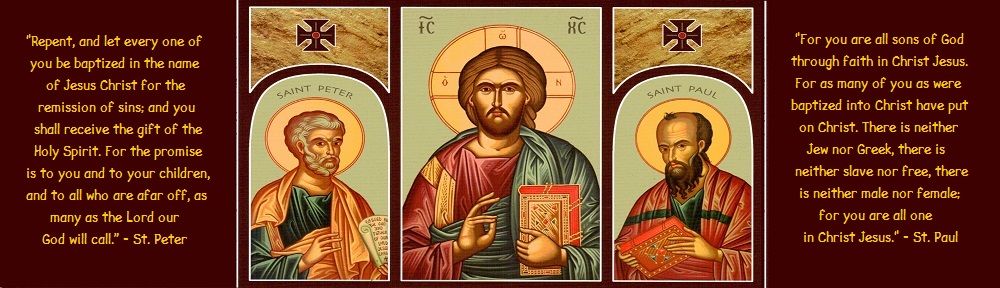
And so Peter called for them all to be baptized, just as the 3,000 Jewish believers had been on the Day of Pentecost. No difference, just as Paul says to the Galatians in chapter 3: For you are all sons of God through faith in Christ Jesus. For as many of you as were baptized into Christ have put on Christ. There is neither Jew nor Greek, there is neither slave nor free, there is neither male nor female; for you are all one in Christ Jesus. And if you are Christ’s, then you are Abraham’s seed, and heirs according to the promise.

Forgiveness of sins is tied to Baptism, Baptism is tied to faith, faith is tied to the word, the word is tied to the Holy Spirit, the Holy Spirit is tied to Jesus, and Jesus is tied to the Father. They all go together. You should never think of one apart from the other. The only thing that you should think of separately are those external, miraculous signs of the Holy Spirit, like speaking in tongues. That was a special thing, a special gift, given, when necessary, for the sake of confirming those four truths that we mentioned, that (1) Jesus Christ is truly Lord of all, (2) that the apostles were truly sent by Jesus, (3) that salvation is truly by faith alone in Jesus Christ, and (4) that salvation is truly for all nations. Or, as Jesus put it to Nicodemus, For God so loved the world that He gave His only begotten Son, that whoever believes in Him should not perish but have everlasting life. For God did not send His Son into the world to condemn the world, but that the world through Him might be saved. Amen.

Source: Sermons

A harvest of life through the Holy Spirit

Sermon

Download Sermon
Service
[vimeo 948109068 w=540 h=360]
Download Service Download Bulletin Download Service Folder</

Sermon for the Festival of the Day of Pentecost

Acts 2:1-13  +  John 14:23-31

Pentecost was originally a sacred harvest festival, one of the mandated feasts of the Old Testament. Seven weeks after the firstfruits of the harvest were gathered, after the first sheaf of a farmer’s wheat crop was offered to the Lord, the Feast of Weeks was to take place, a feast for giving thanks to the Lord for the full harvest that had been brought in—a harvest that had been guaranteed 50 days earlier by the appearance of the firstfruits in the field.

You all know what happened on Easter Sunday. This is what St. Paul says about it in 1 Corinthians 15: But now Christ is risen from the dead, and has become the firstfruits of those who have fallen asleep. Christ, the firstfruits from the dead, rose from the dead on Easter Sunday. And seven weeks later, it was time to celebrate the harvest of what He had accomplished, the harvest of the rest of the Church through the work of the Holy Spirit, a harvest of life that goes on and on until the end of the age.

Jesus had told His apostles to stay in Jerusalem until they received the gift of the Holy Spirit. And so they did. They waited, not knowing exactly how or when the Spirit would come. The events of today’s Epistle reading explain how it happened. There were three signs of His coming.

The first was the sound of a mighty, rushing wind. Unlike Jesus, who came as a man, whom everyone could see with their eyes and touch with their hands and hear with their ears, the Spirit is different. “Spirit,” as you may recall, means “breath” or “wind.” Jesus had once said to Nicodemus, The wind blows where it wishes, and you hear the sound of it, but cannot tell where it comes from and where it goes. So is everyone who is born of the Spirit. Since the Spirit doesn’t interact with us as a human being does, His presence can’t be recognized except through outward signs, much like the wind itself can’t be recognized except by the sound it makes and by the things it blows around. So the Holy Spirit used the sound of a mighty, rushing wind to signal His mighty presence among the believers in Jesus.

The second sign was the appearance of tongues as of fire, resting upon each of Jesus’ disciples. Years earlier, John the Baptist had promised that the Christ would baptize His disciples “with the Holy Spirit and with fire.” This was it. Not the kind of fire that burns or devours. But the kind of fire that spreads. And that fire would spread through tongues, that is, through the speaking, the preaching of the Word of God. As God had said through the prophet Jeremiah, Is not My word like a fire?

The third sign was the sudden ability of the disciples to speak in other tongues, in other languages, in the very languages of the Jews and Jewish converts who were born in other countries, but who were living in Jerusalem at that time. As we learn later, from Paul’s epistles, this wasn’t an ability to actually communicate in those languages, like when you learn a new language. It was, instead, the outpouring of God’s praises in someone else’s language. The speakers didn’t even understand what they were saying. And the point of this sign is obvious: God, in the Old Testament, had focused His attention on the Hebrew-speaking Israelites. He had given them His Word, His covenant, and His promises. The Gentiles were ignored, largely, and allowed to go on living in their wickedness and false beliefs, outside of God’s kingdom. But that would be the case no longer. No longer was God’s attention focused on the Hebrew-speaking Jews living in Jerusalem. Now God was turning to all nations, to bring everyone everywhere into the New Testament in Jesus’ blood, the covenant of the forgiveness of sins through faith in Christ crucified and risen from the dead. This marked the beginning of the fulfillment of Jesus’ parable of the Great Supper, where, after the invited guests, representing the unbelieving Jews, had refused the master’s invitation, He sent out His messengers to gather people “from the highways and the hedges,” Jews and Gentiles, with no respect to anyone’s nationality, or skin color, or bloodline, or language.

The purpose of the signs was very simple: First, to notify the believers themselves that Jesus was, right at that moment, keeping His promise to send them the gift of the Holy Spirit. Second, to attract the crowds in Jerusalem to this gathering of the Christians in Jerusalem, to make them curious and desirous of an explanation. And, third, to confirm that God was indeed with these Christians, that the Gospel they preached was from God.

And so, aided by the Holy Spirit, the apostle Peter preached his Pentecost sermon, which I’d like to read for you in full.

But Peter, standing up with the eleven, raised his voice and said to them, “Men of Judea and all who dwell in Jerusalem…heed my words…This is what was spoken by the prophet Joel: ‘And it shall come to pass in the last days, says God, That I will pour out of My Spirit on all flesh; Your sons and your daughters shall prophesy, Your young men shall see visions, Your old men shall dream dreams. And on My menservants and on My maidservants I will pour out My Spirit in those days; And they shall prophesy. I will show wonders in heaven above And signs in the earth beneath: Blood and fire and vapor of smoke. The sun shall be turned into darkness, And the moon into blood, Before the coming of the great and awesome day of the LORD. And it shall come to pass That whoever calls on the name of the LORD Shall be saved.’

This, Peter says, is the fulfillment of that prophecy from the Book of Joel, that in these “last days,” God would pour out His Holy Spirit on His servants, indicating that these Christians, these believers in Jesus, were the servants of God. And you notice the references in Joel’s prophecy to Jesus’ own prophecies regarding the last days, that there would be wonders in heaven above and signs on the earth, the sun turned to darkness and the moon to blood, which Jesus explains as signs of His imminent return. In other words, the whole New Testament period is being prophesied by Joel, beginning with the outpouring of the Holy Spirit on the Day of Pentecost, and lasting until Jesus comes again. This whole age is the age of the Holy Spirit, the age of the harvest of life, when the gift of salvation is being offered to all.

The next verse from Joel’s prophecy, which Peter didn’t need to add at that time but which I think the world today needs to take into account, goes on: For in Mount Zion and in Jerusalem there shall be deliverance, As the LORD has said, Among the remnant whom the LORD calls. In Mount Zion, in Jerusalem there shall be deliverance, Joel prophesied. But how? What’s the connection to Zion and Jerusalem? It’s not what modern Evangelicals teach, that the city of Jerusalem is and will always remain significant in God’s plan of salvation. No, the connection is clearly to that very outpouring of the Holy Spirit on the day of Pentecost, where deliverance from sin, death, and the devil was indeed proclaimed, through faith in Jesus Christ. From there the Gospel went forth into the rest of the world. So, again, it isn’t about the city of Jerusalem. It’s all about the Gospel. It’s all about Jesus.

All Israel was invited, but not all Israel was to receive the Lord’s Spirit or participate in the kingdom of God from that point forward. Only those who believed the apostles’ preaching, who repented and believed in the Lord Jesus, and were baptized in His name for the forgiveness of sins.

I’d like to continue with more of Peter’s sermon. Listen carefully to how he preached to the people of Israel that day:

“Men of Israel, hear these words: Jesus of Nazareth, a Man attested by God to you by miracles, wonders, and signs which God did through Him in your midst, as you yourselves also know—Him, being delivered by the determined purpose and foreknowledge of God, you have taken by lawless hands, have crucified, and put to death; whom God raised up, having loosed the pains of death, because it was not possible that He should be held by it… This Jesus God has raised up, of which we are all witnesses. Therefore being exalted to the right hand of God, and having received from the Father the promise of the Holy Spirit, He poured out this which you now see and hear…Therefore let all the house of Israel know assuredly that God has made this Jesus, whom you crucified, both Lord and Christ.” Now when they heard this, they were cut to the heart, and said to Peter and the rest of the apostles, “Men, brothers, what shall we do?” Then Peter said to them, “Repent, and let every one of you be baptized in the name of Jesus Christ for the forgiveness of sins; and you will receive the gift of the Holy Spirit. For the promise is to you and to your children, and to all who are afar off, as many as the Lord our God will call.”

And that’s the summary of the whole Gospel. Whoever you are, whatever you’ve done, repent! Repent of all your rebellions against God, of all your failings, of all your breaking of His commandments, and of the prideful trust in your own works to save you, and believe instead in the Lord Jesus who was crucified as the atoning sacrifice for the world’s sins but has now been raised from the dead and reigns at the Father’s right hand. Be baptized in the name of Jesus, the Christ whom God the Father sent, and believe that that baptism in Jesus’ name is for the forgiveness of sins, that God, whom you have offended with your sins, has punished His Son for them, and is now offering to wash them all away and to claim you as His child and to bring you into His kingdom. And know that, as a baptized child of God, you will never again be alone. But, as Jesus promised in today’s Gospel, If anyone loves me, he will keep my word. And my Father will love him, and we will come to him and make a home with him. The Father, the Son, and, as Peter promises, also the Holy Spirit will make a home with you. God will give you the gift of His Holy Spirit.

That isn’t a promise that you’ll speak in tongues. It’s a promise that the Holy Spirit will dwell side by side with your spirit, to preserve you in the faith, to guide you in understanding God’s Word and in applying it to your life, to urge you constantly to live a life of obedience and love, to fill you will courage, comfort, joy, and peace. Not the world’s idea of peace, where you don’t have any problems or conflicts in your life. But Jesus’ version of peace, where you can face any problem and any conflict because you have peace with God through our Lord Jesus Christ, and you are on good terms with the One who is in charge of the universe and of the future.

So praise God today for the Day of Pentecost. Praise and thank Him for including you in His great harvest of life. And make every effort to walk each day in the peace that Jesus has given you, and in the faith and love that the Holy Spirit has worked in you and will continue to work in you. Amen.


Source: Sermons

Soon Babylon will pay

Sermon
Download Sermon
Service
[vimeo 946836195 w=540 h=360]
Download Service Download Bulletin

Sermon for Midweek of Easter 6

Isaiah 47:1-15

Isaiah 47 is all about the fall of Babylon. Which is striking, when you think about it, because, when Isaiah wrote these words, Babylon hadn’t yet become a world power, much less had they done anything to the people and city of Jerusalem. And yet, before Babylon even rose to power, Isaiah prophesies her downfall.

“Come down and sit in the dust, O virgin daughter of Babylon; Sit on the ground without a throne, O daughter of the Chaldeans! For you shall no more be called Tender and delicate.”

The Lord speaks to Babylon as He sometimes speaks to Jerusalem, as the virgin daughter of the king, a noble and prestigious position. And just as King David’s virgin daughter Tamar, once tender and delicate and clothed in a many-colored robe, went away and sat in ashes and mourning after she was violated by her brother Amnon, so God tells Babylon that she will soon be violated, too, and would end up sitting on the ground, in the dust, when the city of Babylon fell to her coming invaders, the Medes and Persians.

Take the millstones and grind meal. Remove your veil, Take off the skirt, Uncover the thigh, Pass through the rivers. Your nakedness shall be uncovered, Yes, your shame will be seen; I will take vengeance, And I will spare no one.”

The enemy of God’s people would be reduced from the status of virgin daughter of the king to that of a slave, living in shame and disgrace. And it would be the Lord’s doing, His vengeance on those who dared to oppress His people.

Our Redeemer, the LORD of hosts is His name, is the Holy One of Israel.

When these things happen to Babylon, Israel will rejoice in God her Savior and will boast about her God, her Redeemer, the Holy One of Israel. What a change, what a great improvement from their former idolatry and rebellion against the LORD of hosts! His punishment of them in Babylon will accomplish its purpose, to wake them up from their shameful idolatry and wickedness, so that they could again acknowledge the goodness and mercy of the Lord.

“Sit in silence, and go into darkness, O daughter of the Chaldeans; For you shall no longer be called The Lady of Kingdoms. I was angry with My people; I have profaned My inheritance, And given them into your hand. You showed them no mercy; On the elderly you laid your yoke very heavily. And you said, ‘I shall be a lady forever,’ So that you did not take these things to heart, Nor remember the latter end of them.

The Lord explains to the Babylonians beforehand that it was He who would allow them to defeat His people, who would enable them and permit them to destroy Jerusalem and take them captive. He was justly angry with them for their wickedness and rebellion. But that didn’t give the Babylonians the right to treat the Israelites poorly in their captivity. We aren’t told the specifics about the abuses that took place against the Jews in Babylon, but clearly they were not treated well. The Babylonians didn’t think they’d ever have to answer to anyone for how they treated God’s people. But they were wrong.

“Therefore hear this now, you who are given to pleasures, Who dwell securely, Who say in your heart, ‘I am, and there is no one else besides me; I shall not sit as a widow, Nor shall I know the loss of children’;

Notice how God describes the Babylonians. Given to pleasures. Dwelling securely in their wickedness. Fooling themselves into thinking that no one could ever defeat them, including God Himself, could ever overthrow them from their elite position. Doesn’t it sound just like the powerful people of the world today, the people of our own country?

But these two things shall come to you In a moment, in one day: The loss of children, and widowhood. They shall come upon you in their fullness Because of the multitude of your sorceries, For the great abundance of your enchantments.

Destruction is coming on the proud enemies of God. Total, utter destruction. And here the Lord adds another component of their wickedness: Their “sorceries and enchantments.” You see, they believed in the supernatural. They acknowledged that there were forces in the universe beyond human ability. But seeking supernatural help or advice anywhere but from God alone is one of those things that will eventually bring down God’s wrath full force on the practitioners of sorcery or witchcraft.

“For you have trusted in your wickedness; You have said, ‘No one sees me’; Your wisdom and your knowledge have warped you; And you have said in your heart, ‘I am, and there is no one else besides me.’

Again, does this sound familiar? You have trusted in your wickedness. Whether it’s sorcery or sexual promiscuity, whether it’s climate activism or abortion activism, or evolutionary propaganda, there is an elitist condescension toward Christians in the world. The unbelievers boast of their wisdom and their knowledge. But the same thing is true today of our culture and of most cultures of the world as was true of the Babylonians: “Your wisdom and your knowledge have warped you.”

Therefore evil shall come upon you; You shall not know from where it arises. And trouble shall fall upon you; You will not be able to put it off. And desolation shall come upon you suddenly, Which you shall not know.

The divine Judge pronounces sentence on the oppressor of His people. Evil. Trouble. Desolation. It would come upon them unexpectedly, and that’s just what happened in 537 BC, when King Belshazzar was indulging in his sinful feast, and the writing appeared on the wall. Daniel told him what it meant, that Babylon was about to fall. And that same night, King Belshazzar was slain, and the Medes and Persians overthrew the city of Babylon.

“Stand now with your enchantments And the multitude of your sorceries, In which you have labored from your youth— Perhaps you will be able to profit, Perhaps you will prevail. You are wearied in the multitude of your counsels; Let now the astrologers, the stargazers, And the monthly prognosticators Stand up and save you From what shall come upon you.

The Lord taunts the Babylonians, who had trusted in their sorcery and astrology, much like the prophet Elijah taunted the prophets of Baal on Mt. Carmel. The lesson for all of them was the same: it’s foolish to trust in false gods. When the Lord decides to act, either to deliver His people or to destroy His enemies, no one can stand against Him.

Behold, they shall be as stubble, The fire shall burn them; They shall not deliver themselves From the power of the flame; It shall not be a coal to be warmed by, Nor a fire to sit before! Thus shall they be to you With whom you have labored, Your merchants from your youth; They shall wander each one to his quarter. No one shall save you.

Thus the Lord finishes His pronouncement of judgment on the Babylonians. The whole chapter was a harsh, unrelenting rebuke of those who would mistreat His chosen people in the future, with no hope of salvation for them whatsoever.

As you know, the Book of Revelation contains very similar language, against Babylon. John says this about Babylon: In the measure that she glorified herself and lived luxuriously, in the same measure give her torment and sorrow; for she says in her heart, ‘I sit as queen, and am no widow, and will not see sorrow.’ Therefore her plagues will come in one day—death and mourning and famine. And she will be utterly burned with fire. John proclaims the fall of Babylon, though no longer the literal Babylon that lies along the River Euphrates, but the figurative “Babylon” of this New Testament period. That Babylon is represented, first, by Rome as it led the way in the early persecutions against the Christian Church, and then also by Rome as the seat of the papacy which so terribly oppressed the Christian Church with its false teachings and tyrannical abuses. And now it has come to represent every enemy of Christians, especially the governments of the world, and every false-teaching anti-Christian institution in the world, that oppresses, persecutes, and mistreats the true children of God, all while claiming to be wise and knowledgeable, noble and prestigious, and unable to be toppled by anyone, including God.

But the dire prophecy of Isaiah 47, combined with the Book of Revelation, paints a very different picture for the enemies of Christ. Just as literal Babylon fell with a great fall, suddenly and with overwhelming destruction, so, too, every human institution that opposes Christ and His Church will fall, by God’s own design and doing.

Until then, let us live humbly, trusting in the Lord’s promise to come and save us at just the right time. And let us love our enemies, and pray for those who persecute us, as Jesus instructed us to do. But let’s not do it believing that the world may, at some time, cease to be our enemy. Some who are enemies now will surely be converted into friends before the end. But Babylon itself won’t be converted. And Babylon won’t fall, until it does, when the Lord Jesus comes for judgment, and His angels proclaim the glad tidings, “Babylon the great is fallen, is fallen! She will be utterly burned with fire, for strong is the Lord God who judges her.” Amen.

Source: Sermons

The testimony about Jesus and its consequences

Sermon
Download Sermon
Service
[vimeo 945583195 w=540 h=360]
Download Service Download Bulletin Download Service Folder</

Sermon for Exaudi – the Sunday after Ascension

1 Peter 4:7-11  +  John 15:26-16:4

For forty days the Paschal candle was lit during our services here, until it was extinguished this past Thursday when we celebrated Jesus’ ascension into heaven. As I said after the service, it seems a little strange, not having it lit anymore. Imagine how Jesus’ disciples felt during those strange ten days between Jesus’ Ascension and the coming of the Holy Spirit on the Day of Pentecost. It was a strange time of limbo, a time for those 120 Christians to do little else but pray and wait.

The eleven apostles didn’t know how long they’d have to wait, but they knew, more or less, what they were waiting for. They were waiting for the Helper, for the Holy Spirit to come to them. They were waiting for what Jesus’ promised: for the testimony of the Holy Spirit—the testimony about Jesus!—and for the beginning of their testimony, too, and for the terrible consequences of it that Jesus referred to in today’s Gospel. That testimony now belongs to us, to the Church that’s built upon it and that still holds it out to the world. That means that the consequences of the testimony also belong to us. But so does the help of the Helper.

But when the Helper comes, whom I will send to you from the Father, the Spirit of truth who proceeds from the Father, he will testify about me.

Jesus promised to send the Holy Spirit after His ascension. He would send Him “from the Father,” because that’s how it works in the Holy Trinity. The Spirit proceeds from the Father, but also from the Son, as we confess in the Nicene Creed, in the sense that the Son is responsible for sending Him into the world from the Father. The Spirit’s work is to testify. But this is important: Notice what the content of His testimony is: “He will testify about Me.” The Spirit’s testimony is about Jesus. He tells what He has seen and heard about Jesus, and, as a Person of the Holy Trinity, the Spirit knows Jesus perfectly. He testified about Jesus throughout the Old Testament and throughout the New. When He spoke by the prophets in the Old Testament, the focus was always on the coming Christ. Now it’s on the Christ who has come. Any supposed testimony of the Holy Spirit that doesn’t focus on Jesus, or that doesn’t tell the truth about Jesus, isn’t coming from the Holy Spirit, but from an unholy spirit.

How would the Spirit of truth testify about Jesus? He would do it in three ways. First, through signs and wonders and various miracles, starting with the miracles of the Day of Pentecost which we’ll consider next week. It was about Jesus, because those signs were always connected to the apostles’ preaching about Jesus, the message that He was the promised Christ, that He suffered for our sins, that He was raised to life for our justification, that He has ascended on high and reigns over all things at the Father’s right hand, that He will return one day for judgment. This outward testimony of the Spirit was important as the apostles began to spread the Gospel throughout the world. But it was temporary; that testimony has been given. It’s done.

There is another testimony of the Spirit, in the hearts of the apostles, enabling them to teach (and to write!) about Jesus correctly. He guided them into all truth, as Jesus said He would. He emboldened them to preach the Gospel of Jesus with new-found courage and conviction—just as He had done, by the way, with the Old Testament prophets, as Peter writes: the Spirit of Christ who was in [the prophets] testified beforehand the sufferings of Christ and the glories that would follow.

Then there is the testimony of the Spirit in the hearts of the hearers of the Gospel as He works through the preaching of the Word, enabling the hearers to believe and understand the Gospel of Jesus. As Paul writes, No one can say that Jesus is Lord except by the Holy Spirit. And again, The Spirit Himself testifies with our spirit that we are children of God, enabling us to cry out to God as our dear Father. You can be confident that, whenever the Gospel is preached, the Spirit is there with His divine testimony, working to convict, to convince, to comfort, and to strengthen our faith in Jesus.

But the Spirit doesn’t testify alone. It’s always connected with that preaching. Jesus goes on in our Gospel, And you also will testify, because you have been with me from the beginning. These words aren’t spoken to all people. They’re spoken to the apostles who were “with Jesus from the beginning.” Theirs is the eyewitness testimony, the testimony on which the Church is founded, together with that of the Old Testament prophets. And, just like the Old Testament prophets, the apostles recorded for us the very words that the Holy Spirit gave them and has faithfully preserved for us in the holy Bible.

You and I cannot offer such testimony. We were not eyewitnesses to everything Jesus said and did, or to His death, or to His resurrection. We can testify to the faith that each of us has in that testimony. We can and should tell the world that we have been convinced that the apostles’ testimony is true, and that Jesus is risen and reigning and returning. But when we invite people to church, when we invite people to know the Lord Jesus, we’re not inviting them to come and hear our testimony. We’re inviting them to come and hear the testimony of the Holy Spirit, through the testimony of the apostles (and prophets), through the Church that has been built on the foundation of the apostles and prophets, Christ Jesus Himself being the chief Cornerstone.

The testifying that the apostles would do was essential. Without it, there would be no Christian Church. But their testifying would not be without consequences. And Jesus wasn’t about to hide those consequences from them.

They will put you out of the synagogues. Yes, the time is coming, when whoever kills you will think he is rendering service to God. They will do these things because they have not known the Father nor Me.

If the Holy Spirit was testifying about Christ in the Old Testament, and if He would continue that testimony in the New Testament era, then you see that the Old Testament Church is really the same Church as the New Testament Church. But, as Jesus predicts here, most of the Jewish people would reject Him and His apostles after Him, proving that they never really knew God the Father rightly, that their version of the Jewish religion was a sham. And they would keep up the sham. They would keep their synagogues. They would hold onto customs and rituals and traditions of the Old Testament. But their Christ-less religion would not tolerate the preachers whom Christ sent out. The synagogues should have naturally turned into Christian churches when the Spirit and the apostles testified there, but instead, the Christ-less Jews would excommunicate the Christian Jews from the synagogues. And they would go further than that. They would persecute and execute the apostles and many who believed the testimony of the apostles, thinking they were serving God as they did it. But they weren’t serving God, Jesus says. They have not known the Father nor Me.

Now, you and I can’t be put out of the synagogues. We didn’t grow up attending one like the apostles did. (Like Jesus Himself did!) But the testimony about Jesus that we believe, the testimony about Jesus that we confess in the world, still draws hatred from Jews and Gentiles alike.

I recently read about a Christian pastor in a foreign country (somewhere in Asia, I think) who requires people to answer a set of questions prior to being baptized. The first question on the list was, “Are you willing to be put to death for being baptized as a Christian?” Another question: “Are you willing to be mocked and ridiculed in the marketplace for being a Christian?” Another: “Are you willing to lose your job for the sake of Christ?” Another question: “Are you ready to be disowned by your father?” I want you to really think about those questions, and your answer to them. Because, over the centuries, Christians have had to face some or all of these consequences for their testimony about Christ. It’s not unexpected. It shouldn’t be unexpected. Remember that I told you beforehand, Jesus says. And when it happens, we shouldn’t be like the student protesters this week who went on a hunger strike…and then complained about how unfair it is that they’re hungry. No, when it happens, before it happens, before you spend another day calling yourself a Christian, you should know what it is you’ve signed up for (or will sign up for).

Who would testify about Jesus, knowing that consequences like these will follow? Only those who believe that Jesus rose from the dead and lives and reigns forever at the Father’s right hand. Only those who believe that heaven is our home and that even death can’t rob us of our eternal life with Christ our Savior, who suffered the same things for us, that we might be saved from sin and death. Only those who know that the consequences of not testifying about Jesus are far worse than the consequences of testifying about Him. Because if we don’t testify, who will? And if no one does, who can be saved?

It’s a lot to ask, a lot to expect. If only we had a Helper to guide us, to strengthen us, to comfort us through it all, to testify along with us and to shore up our testimony? Ah, but we do. The Helper has come, and He is still here. And next week we’ll celebrate the day of His coming. May the Helper, the Spirit of truth, grant you all the help you need, to believe in the testimony about the Lord Jesus and to confess Him before the world, no matter what the earthly consequences may be. Amen.


Source: Sermons