Celebrating Christ’s mission accomplished and work ongoing

Sermon
Download Sermon
Service

To download this video, press here to go to the download page. You may need to scroll down to see the download button.

Download Service Folder Download Bulletin

Sermon for the Festival of the Ascension

Acts 1:1-11  +  Mark 16:14-20

Today’s festival is one of the major festivals of Christ in the whole Church year. It ranks right up there with Christmas and Easter in importance. And yet, believe it or not, I still run into Christians, even Lutherans, who don’t know much about the Festival of the Ascension. So let’s make sure that everyone here, and everyone watching or listening, never (or never again) falls into that category!

As we learn in today’s reading from Acts 1, Jesus appeared on and off to His disciples over the course of 40 days after His resurrection on Easter Sunday. Twice that we know of in Jerusalem, twice that we know of in Galilee, and probably on several occasions we don’t about. He gave them final instructions about the kingdom of God, and about the coming of the Holy Spirit, telling them to wait in Jerusalem until the Spirit should come upon them with power. And then He met with them one last time, on the Mount of Olives, just outside Jerusalem, where Luke tells us that He lifted up His hands and blessed them, and as He was doing that, He was lifted up into the sky, He “ascended” into heaven until a cloud hid Him from their sight. And then, He was “gone.” Gone, in the sense that they never saw Him again. No one on earth ever saw Him again, except for the first martyr Stephen, who was allowed to see Jesus standing at the Father’s right hand before he died, and the apostle Paul, who was called and trained by Jesus directly.

Now, why is that something to celebrate, Jesus being “gone”? Well, as we heard Jesus say a couple of Sundays ago, it was to the Church’s advantage that He went away, because from heaven He would send them the Holy Spirit, who would accompany all the disciples of Jesus everyone in the world at once, whereas, when Jesus walked the earth, He only walked in one place at a time. The Spirit’s work is what would build the Church over the next 2,000 years.

But we celebrate the Spirit’s arrival on the Day of Pentecost, ten days from now. That’s not mainly what we celebrate today. Today we celebrate two things, mainly. We celebrate our  King’s victorious return to His heavenly Father after accomplishing His earthly mission. And we celebrate the beginning of the reign of Christ the King at the right hand of the Father.

That first thing, the King’s victorious return to His heavenly Father, is relatively simple. It doesn’t require too much commentary. Repeatedly Jesus tells His disciples that He was sent by God the Father, that He came from God the Father and would return to God the Father, that He had come down from heaven and would eventually return there. What does that mean?

Well, you and I don’t start out in heaven and then come down to inhabit our bodies. We don’t start with God and then return to God. The rest of us start to exist when we’re conceived. But th eternal Son of God was in heaven prior to His incarnation as a human being. He existed with a divine nature only, like the Father and like the Holy Spirit, without human flesh and blood, without a human nature at all. He “came down” from heaven by means of the incarnation, when He was conceived and took on a human nature in Mary’s womb, a human nature that coexists with His divine nature in one undivided Person, as the One who is both God and Man. That’s how He came down. And then, as both God and Man, He returned to the Father at His ascension. And He returned, not in defeat, but in victory, not in humility, but in glory. Because He had accomplished His mission, the mission which God had planned before the creation of the world, the mission on which the Father had sent Him some 34 years earlier. Jesus had led a perfectly holy, righteous, and sinless life. He had loved God and man without fail. He had tirelessly preached and ministered to the people of Israel, and to a few non-Israelites. He had suffered and died for the sins of mankind and had risen again. The mission was finished successfully. The reason for His coming down to earth was accomplished. Mission accomplished. Time to return to the Father.

And when He did, He received the glory He deserved. Glory as the Son of God, and also as the Son of Man. On the night before He night, Jesus prayed, O Father, glorify Me together with Yourself, with the glory which I had with You before the world was. That was His glory as the Son of God. But after accomplishing His mission to provide redemption for fallen man, He received glory also as the Son of Man, to whom saints and angels sing: Worthy is the Lamb who was slain to receive power and riches and wisdom, and strength and honor and glory and blessing!

And so we join our voices today in glorifying Christ the King, who accomplished His earthly mission to earn mankind’s salvation as the Son of Man, and who has now returned home victorious.

The King’s earthly mission was accomplished, but His heavenly work goes on. And so today we also celebrate the beginning of Christ’s work that He carries out at the right hand of God.

You heard in today’s Gospel that the Lord Jesus was received up into heaven, and sat down at the right hand of God. That’s a fulfillment of Psalm 110, which begins: The LORD said to my Lord, “Sit at My right hand, till I make Your enemies Your footstool.” It’s also a fulfillment of what Jesus said to the Jewish Sanhedrin as they were about to sentence Him to death: I say to you, hereafter you will see the Son of Man sitting at the right hand of the Power, and coming on the clouds of heaven.

What does it mean that Jesus sits at the Father’s right hand?

It isn’t a literal location relative to the Father’s literal location. There are those who claim (mainly the Calvinists and Reformed) that Jesus is physically located in a single place in heaven, from which He cannot move, and from which He certainly cannot cause His true body and blood to be present with the bread and wine of the Lord’s Supper. But they teach falsely. Yes, Jesus has a physical body. But the Father doesn’t! So how can Jesus sit at the right hand of the Father who has no physical hands? How can Jesus be restricted to a location next to the Father who has no physical location? No, to sit at the right hand of God means something else.

Sitting at the right hand of God means that Jesus has been exalted to the highest place, as both God and Man. It means that He has been given all authority in heaven and on earth. As Peter writes, Jesus has gone into heaven and is at the right hand of God, angels and authorities and powers having been made subject to Him. Yes, it means that He has come into His kingdom and has begun His reign as King, with all things in the universe placed under His feet, under His rule.

And what does that reign include?

Jesus once promised His disciples, On this rock—on this confession of Jesus as the Christ, the Son of the living God—I will build My Church. But that building only began to take place after His ascension. From the right hand of the Father, as part of His reign over all things, Jesus is building His Church.

He does that building through the office of the ministry. Jesus Himself is the Chief Minister, the High Priest over God’s Temple. As it says in the book of Hebrews, We have such a High Priest, who is seated at the right hand of the throne of the Majesty in the heavens, a Minister of the sanctuary and of the true tabernacle which the Lord erected, and not man. He Himself is working through earthly ministers whom He has sent and continues to send, as Peter said, God has exalted Him to His right hand to be Prince and Savior, to give repentance to Israel and forgiveness of sins. Through the preaching of Peter, through the preaching of all genuine ministers, through the Sacraments that Jesus instituted before His ascension, Jesus is the one, at the right hand of God, giving repentance and forgiveness, working through His Spirit to bring people to repent of their sins and to trust in Him who was delivered up for our sins and raised for our justification.

And as people are brought to faith, the Lord Jesus, sitting at the Father’s right hand, also justifies and intercedes for believers, pleading with the Father on our behalf. Paul writes, It is God who justifies. Who is he who condemns? It is Christ who died, and furthermore is also risen, who is even at the right hand of God, who also makes intercession for us.

What else? Paul writes that the Father seated Him at His right hand in the heavenly places, far above all principality and power and might and dominion, and every name that is named, not only in this age but also in that which is to come. And He put all things under His feet, and gave Him to be head over all things to the church, which is His body, the fullness of Him who fills all in all. So Jesus reigns as King. He reigns over all things, even over all “principality and power and might and dominion,” that is, the demonic forces of evil in the spirit-realm. He reigns over every government, over every institution, over every individual, over every germ, over every cell in our bodies, over nature, over gravity. He reigns invisibly. He reigns behind the scenes, until He returns to the earth. But we know for certain that every decision this King makes, whether we can see it or not, is for the good of His Church, as the head of a body makes decisions that are good for its own body.

Finally, remember what Jesus said to His disciples on the night before He died. I go to prepare a place for you. And if I go and prepare a place for you, I will come again and will take you to myself, that where I am you may be also. At the right hand of the Father, Jesus is preparing a place for every member of His holy Church, so that our home is ready when He returns in the same way His disciples saw Him go, visibly, coming down from heaven once again, for that final judgment that will mean eternal joy and peace for all who have believed in His name.

That, my Christian friends, is what Jesus’ ascension means for us today. It’s a celebration of Christ’s mission accomplished and also the beginning of His ongoing work, His work whose focus is our salvation. That’s what it’s about. And that’s why we celebrate it, and will continue to celebrate it, on the Thursday that always falls on the 40th day after Easter. Amen.

Source: Sermons

The tasks ahead for Christ and His Church

Sermon
Download Sermon
Service
Download Service Download Bulletin

Sermon for the Ascension of our Lord

Acts 1:1-11  +  Mark 16:14-20

Between Mark’s Gospel and Luke’s account in the book of Acts, we get a pretty well-rounded picture of the time Jesus spent on and off with His disciples after He rose from the dead. Mark condenses it all into a single account, as if it all happened at once. But Luke makes it clear that the various things happened over the course of 40 days, between Resurrection Sunday and Ascension Thursday, as Jesus instructed His disciples about the tasks that Christians would be carrying out after His departure, during this time between His Ascension and His coming again. But if we pull together other sayings of Jesus, and of St. Paul in his Epistles, we see an outline of the tasks ahead, not only for the Church, but for Christ Himself after His ascension.

After Jesus had convinced the eleven apostles on Easter Sunday (and the week after) that He had truly risen from the dead, He immediately began giving them instructions for the tasks that awaited them in the days ahead, following His Ascension. One of those instructions, which applied only to the apostles and believers at that time, was this: To not depart from Jerusalem, but to wait for the promise of the Father, “which,” he said, “you have heard from me. For John baptized with water; but you will be baptized with the Holy Spirit not many days from now.”

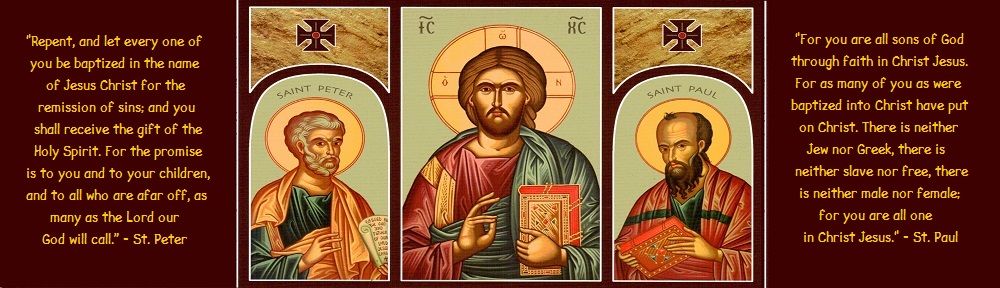
Now, this was, by far, the easiest task Christians would have to do: simply wait. Wait to be “baptized” with the Holy Spirit. Why did Jesus call it a baptism? Not to replace water baptism, since, before His ascension, He Himself had instituted water Baptism and connected a promise of salvation to it: Whoever believes and is baptized will be saved; but whoever does not believe will be condemned. And it wasn’t to institute a “second baptism” that all Christians are to undergo. No, this would be a special gift, the gift of the Holy Spirit, given on the Day of Pentecost, ten days after the Ascension, a gift that would “bathe” them, be “poured out” on them, which is what the word “baptize” really means. But once the Spirit was poured out on the Church, from that time forward, water Baptism included the gift of the Holy Spirit. This is what St. Peter promised to the crowds on Pentecost, “Repent and be baptized…and you will receive the gift of the Holy Spirit.” This is why Baptism is called the “washing of regeneration and renewal of the Holy Spirit,” and why the baptized are said to be “born of water and the Spirit.” We’ll say more about that two Sundays from now.

At that point, the apostles still didn’t understand the tasks Jesus was leaving to them, or the tasks He would be doing. Lord, will you at this time restore the kingdom to Israel? His answer is important. It is not for you to know the times or the seasons which the Father has established by his own authority. It’s not for you to know the timing of God’s plans for the future. Imagine, if the apostles had known it would be some 2,000 years or more before Christ would return. They weren’t supposed to know at that time that earthly Israel would never have the kingdom restored to it, how the nation of Israel was going to keep rejecting the Gospel of Christ, for the most part, and would therefore fade into irrelevance. They weren’t supposed to know that yet, because it would have hindered their preaching to Israel. They weren’t supposed to understand fully how the kingdom of heaven was actually going to incorporate Jews and Gentiles into a new and spiritual Israel, which is the Holy Christian Church. They weren’t supposed to know how God would turn disasters into blessings, or persecutions into growth for the Church. They understood these things eventually, with the Holy Spirit’s guidance, but not yet. It wasn’t their task to know those plans or to plan for those things. It’s not for us to know the timing of God’s plans, either, or to figure out the methods the Lord will use to direct the events of the earth for the building of His Church. That isn’t your task.

It was their task, as apostles, to go into all the world and preach the gospel to every creature, to be my witnesses, both in Jerusalem, and in all Judea and Samaria, and to the ends of the earth. It was their task, and it’s still the Church’s task, to baptize in the name of the Father, and of the Son, and of the Holy Spirit, to teach all nations to observe everything Christ has commanded you, to “do this,” to celebrate the Lord’s Supper, “in remembrance” of Him. It is every Christian’s task to “watch and pray,” to be “sanctified in love,” to “lead holy lives,” to be “imitators of God, as dearly loved children.” It is your task, as Paul writes to the Thessalonians, to “wait for His Son from heaven, whom He raised from the dead, even Jesus who delivers us from the wrath to come.”

All those tasks have been given by Christ to His Church to carry out during this time between His Ascension and His coming at the end of the age, all with the presence, strength, and guidance that His Holy Spirit will continue to provide. And it’s more than enough to keep us busy until Christ comes, whether it’s very, very soon, or whether it’s not during our earthly lifetime.

But He will come. He promised it, and so did the angel on the day of Christ’s Ascension. After Jesus was lifted up into the sky and hidden from the apostles’ sight, two men, two angels, in white clothing stood by them. And they said, “Men of Galilee, why are you standing here looking up into heaven? This same Jesus, who has been taken up from you into heaven, will come in the same way you have seen him go into heaven.”

What does it mean that Jesus was “lifted up” and “hidden from their sight”? It means that Christ, the Head of the Church, would no longer dwell visibly with His Church, which is His body. And yet, the Head hasn’t been severed from the body, as if the Church were now decapitated. He remains the Head, firmly attached to His body, only invisibly. He is by no means far away. On the contrary, St. Paul wrote to the Ephesians, He is the One who ascended far above all the heavens, that He might fill all things. And, God gave Him to be head over all things to the church, which is His body, the fullness of Him who fills all in all.

But what are some of the tasks ahead for Christ, our Head? Well, they’re all summarized by the phrase, “seated at the right hand of God.” As Mark writes, So, then, after the Lord had spoken to them, he was taken up into heaven and sat down at the right hand of God. As we just heard from St. Paul, that’s not a “place” or “location” where Christ is enclosed, far away from us. It’s a position of power and authority as Christ “fills all things.” Paul says in Ephesians, God raised Christ from the dead and seated Him at His right hand in the heavenly places, far above all principality and power and might and dominion, and every name that is named, not only in this age but also in that which is to come. And He put all things under His feet.

And what does He do with that power and authority? His first task was to pour out the gift with which He had promised to “baptize” His apostles. As Peter said, Therefore being exalted to the right hand of God, and having received from the Father the promise of the Holy Spirit, He poured out this which you now see and hear.

What else does Scripture tell us about Christ’s tasks at God’s right hand? St. Paul comforts the Romans with this truth: It is Christ who died, and furthermore is also risen, who is even at the right hand of God, who also makes intercession for us. That means that all who repent of their sins and look to Christ for forgiveness and deliverance from God’s righteous judgment have an Advocate before the Father at all times and never need to fear, as long as they keep looking to Christ in faith.

Jesus Himself had told His disciples earlier about one of His tasks after His ascension: In My Father’s house are many mansions; if it were not so, I would have told you. I go to prepare a place for you. And if I go and prepare a place for you, I will come again and receive you to Myself; that where I am, there you may be also. Even now, Christ Jesus, seated at the right hand of the Father, is fulfilling this promise, seeing to it that you are guarded and guided through this life, seeing to it that you have everything you need to persevere in the faith, including access to the Means of Grace, to Word and Sacrament, so that you reach the mansions of heaven, as long as you use those means and don’t despise them.

In order to provide you with the Means of Grace so that you safely reach that place He’s preparing for you in heaven, the ascended Lord Christ also carries out another task. Paul writes, When He ascended on high, He led captivity captive, and gave gifts to menHe Himself gave some to be apostles, some prophets, some evangelists, and some pastors and teachers, for the equipping of the saints, for the work of ministry, for the edifying of the body of Christ. The existence of pastors is no accident, and no human design. The ministry exists in the Church because Christ gives it from the right hand of God as His tool and instrument for creating and strengthening faith. As Peter says, God has exalted Christ to His right hand to be Prince and Savior, to give repentance to Israel and forgiveness of sins, so that, even though the ministry is carried out by men and the Church is built and nourished and preserved through the ministry of men, Jesus could rightfully say, on this rock I will build My church, and the gates of Hades shall not prevail against it. He even confirmed the preaching of the original ministers He had sent by empowering them to perform miraculous signs, as you heard at the end of the Gospel: They went forth and preached everywhere, and the Lord worked with them, confirming the word with the accompanying signs.

Finally, the ascended Christ carries out another task in which we can take great comfort. Psalm 110 says, The LORD said to my Lord, “Sit at My right hand, till I make Your enemies Your footstool.” And Paul adds in 1 Cor., For He must reign till He has put all enemies under His feet. Do you see the enemies gathering against the Church of Christ? They’re everywhere. The devil rages. The world grows fiercer and fiercer. It’s as Isaiah prophesied:       Justice is turned back, and righteousness stands far away; for truth has stumbled in the public squares, and uprightness cannot enter. Truth is lacking, and he who departs from evil makes himself a prey. But at the right hand of God sits the ascended Lord Christ, who invisibly wages war against His enemies, so that, although they devise evil and carry out wicked plans, it must all serve for the good of those who love Him, until He conquers every enemy at His glorious return.

So truly you have nothing to worry about, nothing to fear. Your Savior reigns at the right hand of God, faithfully carrying out His tasks. So instead of worrying, instead of trying to figure everything out, just go about your own God-given tasks and wait just a little while longer. When all the tasks are finished, Christ will come again, and the reckoning will begin, and those who are still found as living stones in His holy Church will finally see the Head of the Church, to whom you’ve been united through faith all this time. And the Church and her Head will live together as Bride and Groom, happily ever after. It’s a true story. Believe it! And rejoice! Amen.

Source: Sermons

The ascended Lord builds His Church

Sermon for Ascension Day

Acts 1:1-11  +  Mark 16:14-20

By the 40th day after His resurrection, the earthly work of Jesus was 100% complete. He had lived the life every man was supposed to live, a life of perfect obedience to God’s Law. He had died the once-for-all death that atones for the sins of the world. He had defeated death and the devil and risen to life again. He had appeared alive to His disciples on several occasions, leaving behind over five hundred witnesses of His resurrection. He had taught them everything He needed to teach them in person.

The earthly work of Jesus was done, but that doesn’t mean that His work was done. Far from it! A good while before His crucifixion, Jesus asked His disciples, “Who do you say that I am?” Simon Peter answered and said, “You are the Christ, the Son of the living God.” Jesus answered and said to him, “Blessed are you, Simon Bar-Jonah, for flesh and blood has not revealed this to you, but My Father who is in heaven. And I also say to you that you are Peter, and on this rock I will build My church, and the gates of Hades shall not prevail against it.” Today, on Ascension Day, we celebrate the ongoing fulfillment of that promise. Today marks the day when Jesus began His reign at the right hand of God, where the ascended Lord works for no other purpose than to build His Church, as Paul writes to the Ephesians, God seated Christ at His right hand in the heavenly places, far above all principality and power and might and dominion, and every name that is named, not only in this age but also in that which is to come. And He put all things under His feet, and gave Him to be head over all things to the church, which is His body, the fullness of Him who fills all in all.

How does Jesus work? By sending out His apostles, prophets, pastors and teachers, by giving them to His Church as His ambassadors—“ambassadors for Christ” Paul called himself and his fellow ministers. That “sending” began with the eleven apostles, to whom He said: You shall be witnesses to Me in Jerusalem, and in all Judea and Samaria, and to the end of the earth. Like a man going away on a journey, He left His stewards in charge of His house, His Church, both to care for those who were already members of it and to do the work that would bring others into it. Their principal assignment: to preach the Gospel. Preach it everywhere. Preach it to everyone. Go into all the world and preach the gospel to every creature.

What is the Gospel? It’s really the whole message of the Old and New Testaments, which centered around Christ; the “good word” or “good news” that points sinners to Christ Jesus as the Savior of the world. It has been summarized in various ways. At the end of Luke, Jesus summarizes it with these words: Repentance and remission of sins should be preached in Christ’s name to all nations, beginning at Jerusalem. Repentance and remission of sins, for all have sinned and earned eternal condemnation for themselves. But instead of proclaiming that there’s no hope for sinners, the Gospel, the “good news,” is that God has sacrificed His Son for us, and that He is holding out to all people a way out of the devil’s kingdom, a way out of condemnation, a way into His grace and favor. That way is Jesus Christ. He who believes and is baptized will be saved; but he who does not believe will be condemned.

That’s a beautiful summary of the Gospel. But remember, it’s a summary, not the whole of Christ’s teaching. Don’t be fooled by all the people out there who want to reduce the Gospel to “as long as you believe in Jesus, it doesn’t matter what else you do, what else you believe, what else you confess.” In the last chapter of Matthew’s Gospel, Jesus was very clear about what His ministers are to preach and teach and what His Christians throughout the world are to do with that teaching: Make disciples of (that is, teach!) all the nations, baptizing them in the name of the Father and of the Son and of the Holy Spirit, teaching them to observe all things that I have commanded you; and lo, I am with you always, even to the end of the age.

Notice, Jesus says He is with His Church always. And yet, only days after He said this, He was taken up into heaven. So what does His ascension mean?

It simply means that Christ is no longer present with us visibly. It means He has a different way of being with us. It means He’s here, working, building His Church through the preaching of the Gospel and the administration of the Sacraments that He Himself instituted—Baptism and the Lord’s Supper. It means He’s still present with the preachers He sends, and with the saints who hear them, support them, pray for them, and lead holy lives in the world, spreading the Gospel by their example and by their own words.

It means that, although He sits at the right hand of God and reigns over all things, Jesus is right here in our midst, too, hearing our prayers, receiving our worship, sending His Holy Spirit into our midst, and building His Church right here, right now, according to His own plan, according to His own purpose.

We all need to remember this in our little church, in our little diocese. It’s so tempting to look around and ask, what are we doing wrong? Where are all the people? Why aren’t we growing? What will the future hold for us here? But the future isn’t in our hands. It’s in the hands of the One who reigns at God’s right hand, our Savior, our Brother. And He hasn’t revealed His plans or purposes to us, except for this: Do not fear, little flock, for it is your Father’s good pleasure to give you the kingdom.

As for growing and expanding, all of us here would love to see more people in these chairs and throughout our diocese, hearing God’s Word, confessing Christ together with us. But we have to be careful that we don’t let our wishes begin to compete with Christ’s purposes. If He, seated at the right hand of God, chooses to show mercy and grace to our community and to our country by bringing more people to hear His truth purely taught, then He will turn the events of their lives to bring them into contact with us, and the Spirit of truth, through the preaching of the truth, will convince them of the truth. If He, seated at the right hand of God, chooses to harden the hearts of the impenitent, to punish those who cling to their idols, to test our faith, or to glorify His grace and to highlight His strength through our weakness, then we may remain small. But if we believe that Christ ascended into heaven and sits at the right hand of God, then let us also believe that He is Lord of the Church, and that all He does among us is perfect and right and just exactly what He wants to do.

It’s not for us to worry about what happens to Christ’s Church. That job belongs to the One who ascended into heaven and sits at God’s right hand. All that remains for us is to do the very thing He commanded His disciples before He ascended: Preach the Gospel to every creature. Teach. Baptize. Do “this” (celebrate the Sacrament of the Altar) in remembrance of Him. Pray. Support the ministry with your offerings, and support one another with works of love and service. We have our work to do. Let’s do it zealously, trusting in the Lord Jesus to do His own work, and to do it perfectly, until He comes back from heaven in the same way they once watched Him go up into heaven! Until then, the ascended Lord will build His Church. May we, by grace, ever be found within her walls! Amen.


Source: Sermons