Jesus is keeping track of how people treat His brothers

Sermon

Download Sermon
Service
[vimeo 886200319 w=540 h=360]
Download Service Download Bulletin

Sermon for Trinity 26

2 Peter 3:3-14  +  Matthew 25:31-46

We’ve heard a lot about the Last Day in our journey through the book of Revelation on Wednesday evenings, where God teaches us about it in several different pictures. To summarize the events of that day: it will come suddenly, when people aren’t expecting it—though Christians should always be expecting it, knowing, at least in the back of our minds, that it could come at any time. All those who have died will be raised from the dead with new, immortal bodies. Those who are alive, who haven’t died, will be changed and will be given immortal bodies. Those who believed in the Lord Jesus in this life will be gathered to Him in one place. And the rest of mankind will also be gathered together in one place. The final judgment will be pronounced. The heavens and the earth will be destroyed with fire. A new heaven and a new earth will be created. The wicked will go away to eternal punishment, and the righteous to eternal life. That’s a summary of the Bible teaching about the Last Day. And it’s something God warns His people to be ready for, as the main future event we’re preparing for.

Jesus tells His disciples about one little piece of the Last Day in today’s Gospel, painting a picture of the judgment part of the Last Day. It doesn’t describe every detail of the judgment that will be pronounced or everything that led up to that judgment. Instead, it focuses on just one aspect of human behavior that God is keeping record of and that God will reveal on that day. Jesus is keeping track of how people treat His little brothers.

When the Son of Man comes in his glory, and all the holy angels with him, then he will sit upon his glorious throne. And all nations will be gathered before him, and he will separate them one from another, as a shepherd separates the sheep from the goats. And he will set the sheep on his right and the goats on his left.

Jesus spoke these words just days before He was crucified. In a few days’ time His disciples would see him hanging from a cross in shame and apparent defeat. But the shame would be short-lived. And on the Last Day, when He finally returns to the earth, it won’t be in shame or defeat of any kind. It will be as the glorious King of this universe. And instead of standing before a judge, as He stood before the Jewish Sanhedrin and Pontius Pilate on Good Friday, Jesus will return as the Judge of all mankind.

Now, if you have a New King James Bible with section headings, this is one of the places you have to watch out for. The heading that the editors chose to place over these verses is, “The Judgment of the Gentiles.” What, do they think there will be a separate judgment of the Jews? Nowhere does Scripture say that. No, the word “Gentiles” is the same word in the Greek as “nations.” All nations will be gathered before Jesus and immediately separated by Him into two groups. Those whom He places on His right are the favored ones, and those whom He places on His left are the disfavored ones.

Then the King will say to those on his right, ‘Come, you blessed ones of my Father! Inherit the kingdom prepared for you from the foundation of the world.”

King Jesus will invite those on His right to inherit a kingdom, the kingdom prepared for them from the foundation of the world. There’s a lot here. Notice, first, He says, “Inherit!” That affects everything that follows. He doesn’t say, “the kingdom is your reward for all the good things you’ve done, which I’m about to list.” It’s an inheritance. The ones on His right did not earn a place in heaven by their good works. They simply showed themselves, by their works, to be children of God. Now, the only way in Scripture to become a child of God is through faith in Christ Jesus, our Savior and Redeemer, who gave His life on the cross to make atonement for our sins, and who received us into His Father’s family through Baptism and faith.

Notice, too, that this kingdom was prepared for them from the foundation of the world. In other words, these are the chosen people, the ones whom God chose or “elected” in eternity, before the world began, to be adopted as His children and to inherit His kingdom. As the rest of Scripture makes clear, God knew in eternity that mankind would turn away from Him toward sin. But He planned in eternity to send His Son to redeem all mankind. He planned to have the Gospel preached, and to work through the Gospel to bring sinners to faith, to justify believers and to sanctify them in love. It’s that sanctification in love that Jesus goes on to recount to these on His right.

I was hungry, and you gave me food; I was thirsty, and you gave me a drink; I was a stranger, and you took me in; naked, and you clothed me; I was sick, and you visited me; I was in prison, and you came to me. This comes as a surprise to those on the King’s right, because the vast majority of them lived on earth when Jesus wasn’t living on earth. Even those who were alive at the time of Jesus didn’t do all these things for Him directly. But He clears up their confusion. Truly, I tell you, whatever you did for one of the least of these my brothers, you did for me.

One of the main things Jesus commanded His disciples to do was to “love one another.” And by “one another,” He meant your fellow Christians, your brothers and sisters in Christ. That’s what Jesus and the apostles almost always meant when they used the word “brothers,” those who became brothers of Jesus through faith in Jesus. As Jesus said, For whoever does the will of My Father in heaven is My brother and sister and mother. And the will of God the Father is that, first and foremost, all men should repent and believe in Christ Jesus and so become His brothers in the Father’s family. After that, the will of God is the sanctification of Jesus’ brothers, and, again, our sanctification is practiced above all in loving our brothers and sisters in Christ—loving them, not just in our hearts, but in tangible ways, simple ways, like giving food to the Christian who is hungry, a drink of water to a Christian who is thirsty, and so on. And it doesn’t have to be for an “important” Christian, but for the least of Jesus’ brothers. As He said in another place, whoever gives one of these little ones only a cup of cold water in the name of a disciple (that is, because he is a believer in Jesus), truly, I say to you, he shall by no means lose his reward. Those who believed in Christ Jesus and showed mercy and love toward their fellow Christians will be recognized by Jesus on the Last Day, because He keeps track of how people treat His little brothers. He calls them the blessed ones of His Father. He calls them “the righteous,” righteous first by faith, and then righteous in how they lived in this world, especially in how they treated their fellow Christians.

Then there are those who didn’t end their life as children of God, but as unbelievers, as those whom the judge counts as unrighteous. Depart from Me, you who are cursed, into the everlasting fire prepared for the devil and his angels. Notice, first, that these on the King’s left are cursed. As St. Paul says, all who have sinned are under God’s curse. Or, I should say, all who have not been brought out from under the curse through faith in Christ. We all started out life under the curse. But, as Paul writes, Christ has redeemed us from the curse of the law, having become a curse for us (for it is written, “Cursed is everyone who hangs on a tree”), that the blessing of Abraham might come upon the nations in Christ Jesus. But all those in “the nations” who didn’t believe in Christ Jesus remain under the curse.

Also notice, the everlasting fire of hell wasn’t prepared originally for men, but for the devil and his angels. Because God’s purpose in eternity wasn’t to condemn sinners, but that all should come to repentance and to faith in His Son. But, since most people don’t believe in His Son, they will have to answer for their sins. They will taste that everlasting fire together with the devil, for whom it was originally prepared.

Now, the sins committed in the world are beyond measure; they can scarcely be recounted. But here Jesus doesn’t even mention any of the terrible, violent deeds done by men. He only mentions the good deeds that unbelievers failed to do for His little brothers, for His beloved Christians. I was hungry, and you did not give Me food, thirsty and you gave me nothing to drink, etc…Whatever you did not do for one of the least of these, you did not do for me. Jesus takes it personally when unbelievers fail to help His little brothers. Imagine how personally He takes it when they abuse, harm, ridicule, and falsely accuse His brothers! He wants us to know that He will hold all people accountable for all the mistreatment that we have suffered, as well as for all the good treatment we didn’t receive because we remained faithful to our big Brother, Jesus.

And these will go away to eternal punishment, but the righteous to eternal life.

Now, if all that is true, if as Peter says in today’s Epistle, all things here, all things in this universe are destined for destruction by fire, if Jesus is really coming again to pronounce judgment on all mankind, and if He’s keeping track of how people treat His little brothers, then, as Peter writes, What sort of people ought you to be? You ought to practice holy living and godliness, awaiting and yearning for the coming of the day of God…Therefore, beloved, since you await these things, make every effort to be found spotless and blameless before him in peace. Work on this, above all things! Work on being found spotless and blameless before God when He comes to judge the earth. Work on behaving in the world like children of light and not like everyone around you who still lives in darkness. Work on treating your fellow Christians with love and respect at all times, remembering at all times that the King is keeping track of how people treat His little brothers. But as you work on those things, don’t put your faith in how well you’ve treated anyone. Put your faith only in the Lord Jesus, and eagerly wait for His coming! Amen.

Source: Sermons

Come, I will show you the Bride of the Lamb!

Sermon
Download Sermon
Service
[vimeo 885067791 w=540 h=360]
Download Service Download Bulletin

Sermon for Midweek of Trinity 25

Revelation 21:9-27

We’ve made it almost all the way through the Book of Revelation. These last three readings contain no more struggle, no more warfare, no more persecution, no more pain. We’ve made it through all the visions that repeated, over and over, the struggles of the Church in this New Testament era. The rest of the book describes what things will be like for the faithful after Christ returns. We’re given a picture of the eternal life that awaits.

And that’s useful for us! Because, we haven’t yet reached the end of the story. You and I and the rest of the Church Militant are still in the thick of it, in a warzone. We’re surrounded by enemies. The fight is fierce, the warfare long. The life of a Christian is a hard life. It has to be! Because it has to resemble the life of the One whom we call our Lord, a life still characterized here by the cross. Will it all be worth it? It will! Revelation gives us a glimpse of how the story ends. Tonight the angel invites us to join the Apostle John in contemplating what the Church of Christ will look like after Christ returns. Come!, he says. I will show you the Bride of the Lamb!

Then one of the seven angels who had the seven bowls filled with the seven last plagues came to me and talked with me, saying, “Come, I will show you the bride, the Lamb’s wife.” And he carried me away in the Spirit to a great and high mountain, and showed me the great city, the holy Jerusalem, descending out of heaven from God, having the glory of God. Her light was like a most precious stone, like a jasper stone, clear as crystal.

In the picture-language of Revelation, lots of vivid imagery gets all mixed together. Christ is depicted as a Lamb, and also as a Bridegroom; the Church as his bride, and, at the same time, the Church as a city. At the end of the story, there will be the Church of Christ, the New Jerusalem, coming down out of heaven from God – a holy city, a brilliant, shining, glorious city – sparkling like a diamond as it descends.

The question is, how did the Church get that way? Because it certainly didn’t start out that way. The bright, shiny Church at the end of the story is the same Church that, in the Old Testament, God called a filthy harlot. The beautiful, holy Church at the end of the story is the same New Testament Church that doesn’t look at all pretty this side of heaven—by schisms rent asunder, by heresies distressed. The Church on earth is made up of both true believers and hypocrites. It’s filled with sinners, every last member. But the Church at the end of the story has no sin in it whatsoever. Where did all the sin go?

It went to the Lamb, of course, the Lamb of God who takes away the sin of the world. Christ, the holy Lamb of God, sacrificed himself on the cross for the filthy sins of his Bride-to-be, called her to repentance and faith, washed her and made her clean in the waters of Holy Baptism. As Paul says in Ephesians 5, “Husbands, love your wives, just as Christ also loved the church and gave Himself for her, that He might sanctify and cleanse her with the washing of water by the word, that He might present her to Himself a glorious church, not having spot or wrinkle or any such thing, but that she should be holy and without blemish..” Isn’t that just the picture John is describing here at the end of the story? A Church made up of people whose sins were all forgiven here in this life, and who have finally shed the sinful flesh entirely, so that they no longer commit any sin.

The angel goes on to describe the Bride of the Lamb, the City of God. She had a great and high wall with twelve gates (made of pearls, by the way, which is why they’re sometimes called the “pearly gates”), and twelve angels at the gates, and names written on them, which are the names of the twelve tribes of the children of Israel: three gates on the east, three gates on the north, three gates on the south, and three gates on the west.

Twelve gates. Twelve angels. Twelve tribes of Israel. Twelve. The number that symbolizes God’s Church. People from north, south, east and west have come into it. People from every nation, tribe, language and people have been built together into a single city, a New Jerusalem for a New Israel, made up of both Jews and Gentiles who either looked forward to the coming of Jesus the Christ before He came, or who believed the word of the apostles after He came.

And so the description continues: The wall of the city had twelve foundations, and on them were the names of the twelve apostles of the Lamb. This sounds so much like what Paul said in Ephesians 2, “Consequently, you are no longer foreigners and aliens, but fellow citizens with God’s people and members of God’s household, built on the foundation of the apostles and prophets, with Christ Jesus himself as the chief cornerstone.” We enter this city by faith in the blood of the Lamb, and that faith comes from hearing the message, the Word of Christ, handed down to us by the apostles of the Lamb.

At this point in the story, the point in which we live, it seems like the Church could dwindle down to nothing. But skip ahead to the end of the story. Come, says the angel. I will show you the bride of the Lamb! 12,000 furlongs wide by 12,000 furlongs long, by 12,000 furlongs high. That’s about 1,380 cubic miles—miles! That’s a city bigger than the state of Texas, and reaching far into outer space, with walls that are 144 cubits thick—that’s over 200 feet thick. But the numbers are symbolic. 12,000 is 12 x 10 x 10 x 10. 144 is 12 x 12. It’s the full number of the elect. See what God’s Word will accomplish before time is done. See this immense city coming down out of heaven and know that it was God’s Holy Spirit who built that city by the simple preaching of the Word of God, by the simple administration of the Sacraments of the Lord Jesus. See how valuable our time will have been spent, gathered here around Word and Sacrament, and studying God’s Word, and speaking God’s Word in the world.

Come, says the angel. I will show you the bride of the Lamb! I saw no temple in the city, for its temple is the Lord God the Almighty and the Lamb. And the city has no need of sun or moon to shine on it, for the glory of God gives it light, and its lamp is the Lamb. By its light will the nations walk, and the kings of the earth will bring their glory into it, and its gates will never be shut by day—and there will be no night there. They will bring into it the glory and the honor of the nations. But nothing unclean will ever enter it, nor anyone who does what is detestable or false, but only those who are written in the Lamb’s book of life.

This is the goal. This is the prize we’re striving to win, the light at the end of the tunnel, that the Almighty Father who loved you and gave His Son for you will come and make His home with you visibly and tangibly, that the Son of God, the Lamb who gave His life for you, will come and make His home with you visibly and will shine on you with everlasting light. This is why you must keep fighting. This is why you must persevere under hardship and remain faithful until death, why you must bear the blessed cross, why you must cling to the Word and the Sacraments, because this is what’s waiting for you. This is the prize, to live under Christ in his kingdom and to serve him with everlasting righteousness, innocence, and blessedness, just as He has risen from death and lives and reigns eternally.

How will the story end? It’s no surprise ending for us Christians. The story of this world will end in glorious victory for all who trust in Christ Jesus. But after the end of the story of earth begins a new story in the City of God. Now, that’s the real surprise, the ultimate adventure. How will that story go? You’ll just have to finish the book to find out. Amen.

Source: Sermons

Flee from idolatry in all its forms

Sermon

Download Sermon
Service
[vimeo 883780937 w=540 h=360]
Download Service Download Bulletin

Sermon for Third-to-last Sunday (Trinity 25)

1 Thessalonians 4:13-18  +  Matthew 24:15-28

Today the lectionary begins turning our thoughts to the end times, to the state of the world and of the Church leading up to Christ’s return. It isn’t a pretty picture. But there is hope in it! Not the hope of a better world here, but the promise of God’s protection and help as we live through the dark days of the great tribulation. Alongside that promise, though, comes a warning from the Lord Jesus, an urgent warning to flee from the idolatry that will afflict the Church as we wait for Him to return.

Jesus is talking with His disciples about the signs leading up to His coming at the Last Day. He foretells a horrible event from the beginning of the New Testament period—the destruction of Jerusalem in the first century. And He uses that same event as a metaphor for the last days.

Therefore, He says, when you see the abomination of desolation, spoken of by the prophet Daniel, standing in the holy place (let the reader understand), then let those who are in Judea flee to the mountains. The Old Testament prophets often refer to idols as abominations, things that God truly hates. A desolation is something that lays waste to an area. Daniel, who lived about 600 years before Christ, prophesied that an idol would be set up in the holy place, in the innermost part of the temple in Jerusalem, right next to the place where God had promised to dwell. That prophecy was partially fulfilled some 400 years later when Antiochus Epiphanes, the commander of the Greek forces in Syria, would oppress the Jews over the course of about three years, banning their religion and literally setting up an idol in the temple. But Jesus applies Daniel’s prophecy to another event yet to come, to the idolatry of the Jews who would reject Him, who would still use the temple in Jerusalem to make sacrifices for sin, mocking the sacrifice of Christ that had already been made once for all on the cross. That idolatry was the reason why God allowed the Roman armies to come in in 70 AD to cause desolation, to besiege and finally destroy Jerusalem.

Just as Scripture often uses the literal kingdom of Israel in the Old Testament as a figure of the spiritual kingdom of Christ in the New Testament, so Jesus uses that literal idol in the literal holy place and the resulting desolation in the literal city of Jerusalem to represent a spiritual abomination, a spiritual idol (or idols) in the spiritual temple of God, which is the Holy Christian Church. As He says here when he refers to the “holy place,” let the reader understand. There’s something figurative in this saying that Jesus wants us to notice.

The idolatry that grew in the holy place of the Holy Christian Church over the centuries was the papistic idolatry, the idolatry of the Roman Church, as the hierarchy began to set the saints and their merits next to Christ in the holy place of the Church, setting the penances and satisfactions of the Christian next to the atonement made by Christ, setting the pope and the Church’s hierarchy next to Christ and actually above Christ because the pope’s teaching contradicted the word of Christ, and yet he was to be believed instead of Christ, which is why Lutherans refer to the papacy as the Antichrist, or at least as the ultimate Antichrist. Because not all the idols that have been set up in the Church can be traced directly to the papacy.

Or maybe they can, in a way, if “popery” is considered more generally. Every time a teaching is set up in the Church that contradicts the Word of Christ and is supposed to be believed instead of Christ, you have a little pope there, don’t you? Every time a man (a pastor or a priest or a minister) insists on being obeyed in the Church when he’s teaching something other than the word of Christ, you have a little pope there. Every time a synod or a church body or diocese demands your loyalty, regardless of the Word of Christ, or every time Christians give their loyalty to a synod or a church body or a minister, regardless of the Word of Christ, you have a little pope there, a little antichrist, an idol, an abomination that will cause desolation.

So, “Flee!” Jesus says. Fleeing ahead of the Roman armies was a physical fleeing, and all those who listened to Jesus’ warning were able to escape Jerusalem before the desolation came. Fleeing from all these other idols is a spiritual kind of fleeing, although there may be some physical fleeing involved, too. Run away from that church or that church body that has set up an idol where only Christ belongs. Get out of the assembly where idolatry, even secret idolatry, is being openly practiced. Run away in your heart from every idol that you might fear, love, or trust in more than God.

Flee! And do it without delay! That’s what Jesus’ instructions boil down to. Let the one who is on the housetop not come down to get anything out of his house. And let the one who is in the field not turn back to get his clothes. But woe to the women who are with child and who are nursing in those days! Pray that your flight is not in the winter or on the Sabbath! In other words, anything that hinders your flight from where idolatry has taken hold in the Church will harm you! Getting away from it is urgent, and all the more urgent as the Last Day approaches, when the tribulation will be at its greatest.

You see, fleeing from Rome and from all the idols that are set up within the visible Church is essential to avoid the desolation it will cause—the desolation of souls! But it doesn’t get you out of the great tribulation. Jesus says, For then there will be great tribulation, such as has not happened since the beginning of the world until now, nor will there ever be. Indeed, if those days were not shortened, no flesh would be saved. But for the sake of the elect those days will be shortened. The Book of Revelation talks about the saints who were even then “coming out of the great tribulation.” So, in a sense, it’s been going on since the first century. But just as the first abomination of desolation was literal and the second is spiritual or figurative, so might the tribulation be. The great tribulation of the first century involved severe physical persecution and torture of the saints. The great tribulation near the end of the world may be much more of a spiritual tribulation, trouble and affliction of the spirit, the trouble of being surrounded and assaulted by false doctrine, the trouble of having a hundred different Christian church bodies, the trouble of a world that completely and thoroughly rejects God’s Word, natural law, and justice. The public schools of our country (and in most of the world) teach a sort of “gentle atheism.” They don’t come right out and say God doesn’t exist, or that all religion is evil. They just unteach everything the Bible teaches and replace it with a false history, false morality, false authority, and a false purpose for mankind. They train generations of citizens not to rely on God’s word, but on “science” and the ingenuity of the human race. Practically all the world powers deny Christ, if not by name, then by policy and by action. This is all part of the great tribulation, the work of the Antichrist, and it would be too much even for the elect to withstand, if God didn’t shorten the days for us. But Jesus promises here that those days will be shortened.

Now, sometimes He shortens the days by giving us a brief reprieve, a few moments of sanity and normalcy. But those reprieves are temporary. Sometimes He shortens the days by bringing believers out of this life, so that we finish our race in faith and win the battle by leaving the battle with our faith intact. But in the end, only the coming of Christ will truly shorten the days of the great tribulation.

Jesus has further warnings for those who live in the great tribulation: “Then if anyone says to you, ‘Look, here is Christ!’ or ‘There!’ do not believe it. For there will arise false christs, and false prophets, and they will perform great signs and wonders, so as to deceive even the elect, if that were possible. See, I have told you ahead of time. False prophets pointing to false christs. Isn’t that exactly what we see in the Church at large? False prophets pointing to evolutionary Jesus, who didn’t create the world in six days; pointing to LGBT Jesus, who didn’t create them male and female and institute marriage between a man and a woman; pointing to socialist Jesus who compels people to charity by force; pointing to tolerant Jesus who would never dare judge anyone for anything—except for intolerance.

That’s the false Jesus on the liberal side. But then there are plenty of false prophets on the more “conservative” side who point to American patriot Jesus; or to contemporary worship Jesus on the one hand or to strict traditionalist Jesus on the other; or to the Jesus who forbids the little children to come to Him through Holy Baptism; or to rapture Jesus who still supposedly calls on Christians to support the Israel that rejects Him as Lord. The list goes on.

Therefore, if they say to you, ‘Look, he is in the desert!’ do not go out; or, ‘Look, he is in the inner rooms!’ do not believe it. For as the lightning comes out of the east and is visible in the west, so also will be the coming of the Son of Man. There is only one true Jesus Christ, who has ascended into heaven and will not return until the very Last Day of this world when every eye will see Him. Until then, He has left a sure and dependable witness of His teaching: His words faithfully recorded in Holy Scripture and faithfully confessed in the ancient creeds of the Church. And He has left a ministry of the Word that carries His blessing and His authority. If you go seeking Jesus apart from His Word and the ministry of it, you will only find a false christ.

Our Gospel concludes with that rather strange saying: For where the carcass lies, there the eagles will gather. It’s actually a paraphrase from the book of Job, where God is scolding Job for thinking himself wiser than God. And God has to remind him that God is the one who gave the eagle the nature and the ability to spy out the landscape from afar, to pinpoint where the dead body is, and to gather there. So it is with God’s children. We won’t miss Jesus at His coming. We won’t miss out on the eternal life He will bring. Instead, St. Paul describes the scene of the Last Day beautifully in today’s Epistle, when both those believers who have died and those believers who are still alive on that day will all be gathered around the Lord Jesus: For the Lord himself will descend from heaven with a shout, with the voice of the archangel, and with the trumpet of God, and the dead in Christ will rise first. Then we who are alive and remain will be caught up together with them in the clouds, to meet the Lord in the air. And so we will always be with the Lord.

Such is the wisdom of God, to allow His visible Church to falter and to embrace the idol, and to allow His true believers, His invisible Church, to suffer much during this great tribulation. But rather than question God’s wisdom as Job did, let us embrace it and acknowledge that God knows far better than we do what is right and necessary for this world and for His beloved Church, including each one of His dear children. Trust in Him. Watch out for idols and flee from them, wherever they are set up. Seek Him in His word and the ministry of it during this great tribulation. And eagerly expect His coming! Amen.

Source: Sermons

Something new is coming

Sermon
Download Sermon
Service
[vimeo 882740777 w=540 h=360]
Download Service Download Bulletin

Sermon for Midweek of Trinity 22

Revelation 21:1-8

We’ve all had that special thing we really loved—a toy, a car, a tool, a piece of equipment, a piece of clothing—that eventually broke, or got torn, or damaged somehow. We may have tried to repair it or patch it, keep it running, keep using it for a while. But eventually we knew, it was just too broken, beyond repair. We had to get rid of it. We had to replace it with something new.

That’s God’s evaluation of this earth, of this universe. He created it good. But it broke very quickly, when man fell into sin. Since then, God has been sustaining it, holding it together, keeping it running, because He had a purpose and a use for it still—to prepare the world for the coming of His Son, to give His Son into death for our sins, to build a Church through the preaching of the Gospel. But soon that purpose will be completed. And then, God won’t try to repair the earth. It’s just too broken. Instead, He will replace it with something new. That’s what John sees in his vision in Revelation 21. Something new is coming.

Now I saw a new heaven and a new earth, for the first heaven and the first earth had passed away. This verse, and really this whole section, mirrors the prophet Isaiah’s words in the last two chapters of his book. For example, Isaiah writes: For behold, I create new heavens and a new earth; and the former shall not be remembered or come to mind. There’s no use trying to save this planet, or trying to populate a new one, like Mars, as some are obsessed with doing. It’s not possible. It’s not worth it. God is about to get rid of this broken world and this broken universe. And the new heaven and earth will be so much better, in every way, that no one will even miss what we had here. As Paul wrote to the Romans, I consider that the sufferings of this present time are not worthy to be compared with the glory which shall be revealed in us. For the earnest expectation of the creation eagerly waits for the revealing of the sons of God. For the creation was subjected to futility, not willingly, but because of Him who subjected it in hope; because the creation itself also will be delivered from the bondage of corruption into the glorious liberty of the children of God.

John continues his description of the new heaven and earth: Also there was no more sea. The problem with the sea is that it’s uninhabitable by man. In fact, most of the earth is covered with sea, making most of the earth uninhabitable. But the new earth won’t have that problem. The whole earth will be designed for God’s people to live in it and to prosper in it.

Then I, John, saw the holy city, New Jerusalem, coming down out of heaven from God, prepared as a bride adorned for her husband.

Jerusalem, in the Bible, is used in at least two different ways. It sometimes refers to the actual city that David conquered from the Jebusites and that became the capital city of Israel and the home of Solomon’s temple. It often refers to the visible Church of God, either before the coming of Christ, when the city of Jerusalem was still the literal capital of the Church, or after the coming of Christ, when the Church is no longer tied to any single geographical location but has spread throughout the whole world. But the visible Church has always been made up of both believers and hypocrites—people who are outwardly members of the Church but inwardly unbelieving and sometimes hostile toward the believing members.

But there’s a New Jerusalem coming, one that won’t be a mixture of believers and hypocrites, one in which only believers in the true God—Father, Son, and Holy Spirit—are found. It’s coming down out of heaven from God, or, as God says through Isaiah: For behold, I create Jerusalem as a rejoicing, and her people a joy. I will rejoice in Jerusalem, and joy in My people.

John writes, I heard a loud voice from heaven saying, “Behold, the tabernacle of God is with men, and He will dwell with them, and they shall be His people. God Himself will be with them and be their God.” God walked in the Garden of Eden with Adam and Eve until they sinned. Then He didn’t walk among men anymore in the same way. He had Moses build a portable tabernacle, and later a permanent temple, so that God could dwell with men on earth. But it was a limited dwelling, where men couldn’t see or interact with God. Then, for about 33 years, God tabernacled among men in the Person of His Son. John says in chapter 1 of His Gospel, The Word became flesh and dwelled or “tabernacled” among us.” But that was wasn’t meant to last forever, either, and the divinity of Christ was still veiled and hidden most of the time. Now we don’t see God. We aren’t able to ask Him questions and hear His answers. He interacts with us through the medium of His Word and Sacraments. But the time is coming when He will make His permanent, visible dwelling among His people. He won’t work in hidden, mysterious ways anymore. We won’t have to wonder what His plans are. And we won’t have to constantly be waiting for the next shoe to drop, for the next disaster to strike.

As John writes, And God will wipe away every tear from their eyes; there shall be no more death, nor sorrow, nor crying. There shall be no more pain, for the former things have passed away. Then He who sat on the throne said, “Behold, I make all things new.” And He said to me, “Write, for these words are true and faithful.”

We heard very similar words in chapter 7 talking about the souls of those who are already in heaven. But here it’s applied to all God’s people in the new earth and the New Jerusalem. It’s hard for us even to imagine a world like this, a life like this, untainted by sorrow, pain, or loss, with no fear of what tragedy or bad news may be just around the corner. But God would have you try to imagine it, try to picture it, and definitely look forward to it and let it comfort you here, because the valley of the shadow of death is not the final destination of the Christian. It’s only a stop along the way to a better and permanent life.

And He said to me, “It is done! I am the Alpha and the Omega, the Beginning and the End. I will give of the fountain of the water of life freely to him who thirsts.

There, at the end of this world and at the beginning of the next, stands our God. He never changed. He never wavered. Everything around us will be new, but God will remain the same, the same, faithful Father who only kept this old world going long enough to bring salvation to all who would be saved; the same faithful Lord Jesus who was with God in the beginning, who became our Brother, and who will remain with us forever; the same faithful Holy Spirit who was the finger of God in creating this earth, who brought the water of life to us here in Word and Sacrament, and who will sustain us forever in the new heavens and earth.

He who overcomes shall inherit all things, and I will be his God and he shall be My son.

This is the true promise of God to Abraham, that His Seed would inherit, not just a plot of land by the Mediterranean Sea, but would inherit the earth. That Seed is Christ, and all who are joined to Him by faith. We’ve been made sons of God here through Baptism and faith in Christ Jesus, and we’ll remain His sons forever and inherit all things together with Him, if we overcome.

And so, again, that’s the lesson for us here. Look forward to the new heavens and the new earth, to the end of pain and suffering, to everything being made new and fresh and permanently good. And, be diligent to overcome, with God’s help, all the obstacles the devil will put in your way until the day when God makes all things new, so that you don’t end up in the wrong group.

But the cowardly, unbelieving, abominable, murderers, sexually immoral, sorcerers, idolaters, and all liars shall have their part in the lake which burns with fire and brimstone, which is the second death.

All those vices mentioned here are perfectly fitting for this old, broken world, and for the burning lake of fire, but not for the new habitation that God will create. If it’s the new home you have your heart set on, if it’s the New Jerusalem where you wish to live, then rehearse for life in that place, and turn away from all those things that characterize the broken sinfulness of this place. Set your heart on the new creation, and walk in the new life of the children of God until you get there. Amen.

Source: Sermons

Blessed are the saints on earth and in heaven

Sermon
Download Sermon
Service
[vimeo 880376359 w=540 h=360]
Download Service Download Bulletin

Sermon for All Saints’ Day

Revelation 7:2-17  +  Matthew 5:1-12

Today we remember all the saints: the apostles, prophets, and martyrs of the Church of Christ, together with all the faithful who have gone before us: Old Testament believers in the coming Christ, and New Testament believers who were washed in the Baptism of Christ and made holy by faith in His blood, who bore the cross with patience, who persevered in faith until the end and have now received the crown of life. They are the ones who have come out of the great tribulation and are before the throne of God, and serve Him day and night in His temple. As it says elsewhere in the book of Revelation, Blessed are the dead who die in the Lord from now on. Yes, says the Spirit, for they will rest from their labors, and their works follow them. The saints above are truly blessed.

But so are we. So are we, if we have the qualities that Jesus describes in the Beatitudes at the beginning of the Sermon on the Mount, that is, simply the qualities of a true Christian. Those who do, Jesus calls “blessed.”

The word for “blessed” used here in the Beatitudes means “happy.” It doesn’t mean they always feel happy. It means they have good reason to be happy, either because of something they already have and enjoy, or because of something they will most surely have and enjoy in the future. So whether we’re talking about the saints above or the saints below, those who have the qualities Jesus describes here have good reason to be happy.

Jesus says, Blessed are the poor in spirit. What kind of poor people is Jesus talking about here? The poor “in spirit.” They may be the richest people on earth, or the poorest people on earth financially. That doesn’t matter at all. Rich or poor by earthly standards, they have good reason to be happy if they’re poor in spirit, that is, if they humble themselves before God, if they view themselves as beggars before Him—beggars in need of God’s mercy and grace.

Why do they have good reason to be happy? For theirs is the kingdom of heaven. No matter how much or how little you possess on earth, it will sooner or later be destroyed. It won’t be yours forever. It won’t last. What will last forever is the kingdom of heaven, where Christ reigns as a good and just King over His subjects, where Christ provides free forgiveness of sins and every grace and blessing, where all the members of the kingdom are dearly loved children of God the Father. This kingdom belongs only to the poor in spirit, making them the richest people on earth. And, after this life, the souls of those who were poor in spirit here now live with Christ in eternal righteousness, innocence, and blessedness.

Blessed are those who mourn. Now, there are two kinds of mourning. There’s a mourning over your sins, which we call contrition, grieving over the countless ways you’ve sinned against God. And there’s a mourning over the effects of sin in the world: pain and loss, suffering and death, other people’s hatred, or mistreatment, or injustice, to watch as wickedness prospers and as righteousness is defeated. True Christians mourn for all these reasons, because of their own sins and because of the tragic effects of sin in the world. They know better than to blame God for any of it. They blame themselves for their part in it, they blame sin, and they blame the devil who dragged our race into it. And they mourn over it.

Why do those who mourn have good reason to be happy? Because of Jesus’ promise, They will be comforted. Already here and now those who mourn over their sins are told the comforting truth: The blood of Jesus Christ His Son cleanses us from all sin. Already here and now, those mourners who confess their sins hear God’s own absolution spoken by the pastor: Your sins are forgiven you, in the name of the Father, and of the Son, and of the Holy Spirit. Already here and now those who mourn over all the sad effects of sin in the world are comforted with the fact that Christ reigns at the right hand of God, and with the knowledge that God works all things together for good to those who love Him. Already here those who mourn the death of a fellow Christian are comforted with the sure promise of the resurrection and eternal life, and that’s good reason to be happy, even in the midst of mourning.

How much more are the saints above comforted! As John described them in his vision, They will no longer hunger and no longer thirst; neither the sun nor any heat will strike them; for the Lamb who is in the midst of the throne will shepherd them and lead them to living springs of water. And God will wipe away every tear from their eyes.

Blessed are the meek. Also translated “gentle” or “lowly.” It’s that aspect of love that St. Paul described to the Corinthians, love that does not parade itself, is not puffed up; does not behave rudely, does not seek its own, is not provoked. It’s the attitude of Jesus, who said, Take my yoke upon you and learn from me for I am gentle (meek) and humble of heart. To be meek doesn’t mean that you can never be forceful or never take a stand. It just you’re not overbearing and arrogant and self-seeking.

Why do the meek have good reason to be happy? After all, they are often the ones who finish last here on earth. Their happiness lies in Jesus’ promise. They will inherit the earth. They will “inherit” it because they have been given the right to become children of God through faith in Christ. And as all things belong to Christ, so all things belong to those who are in Christ. Now, neither the saints in heaven nor the saints on earth have received this inheritance yet, but it’s there, waiting. As Peter says, Blessed be the God and Father of our Lord Jesus Christ, who according to His abundant mercy has begotten us again to a living hope through the resurrection of Jesus Christ from the dead, to an inheritance incorruptible and undefiled and that does not fade away, reserved in heaven for you, who are kept by the power of God through faith for salvation ready to be revealed in the last time.

Blessed are those who hunger and thirst for righteousness. Just as there were two kinds of mourning, so there are also two kinds of righteousness for which people hunger. There is the righteousness before God, and there is righteousness or justice among men.

Why do those who hunger and thirst for righteousness have good reason to be happy? Because already here and now, those who believe in Christ and who have been baptized into Christ have His righteousness as a robe to wear at all times. That’s the righteousness that counts before God and that makes us righteous in his sight.

As for righteousness or justice among men, we won’t see much of that here in this life. On the contrary, we’ll continue to see injustice grow, and we’ll continue to struggle against our own unrighteous flesh. But according to God’s own promise, we will see perfect justice in the Day of Judgment, which is coming soon, and in the next life, where the saints above now see it. We’ll be rid of all sin forever, as the saints above are now rid of it.

Blessed are the merciful. Those who are truly merciful, who truly look on their fellow man with mercy and compassion and pity, are just imitating their Father in heaven, as Jesus told us to do, Be merciful just as your Father also is merciful. They’re merciful toward others because they already know God’s mercy toward them in giving His Son into death for those who were, at the time, His enemies. They’ve already received God’s mercy.

Why do those who show mercy have good reason to be happy? Because they will be shown mercy. Believers in Christ, who have received God’s mercy in the forgiveness of sins, will now show mercy toward others, and, God, in turn, will show them even more mercy, as He no longer judges our deeds according to the strictness of His Law, but instead looks mercifully at the works we do from faith in Christ, and accepts them, and even rewards them in His mercy.

Blessed are the pure in heart. A pure heart is genuine, sincere, and honest with God and with men. It doesn’t pretend. It isn’t hypocritical. It doesn’t have false motives, but seeks God in genuine repentance and faith and shows genuine love to our neighbor. It’s the heart of the New Man that has been created in Christians, even as we still drag around with us the impure heart of the Old Man and struggle against it. But if we walk according to the Spirit, if the pure heart of the New Man dominates within us, then we are said to be pure in heart.

What’s their reason for happiness? They will see God. Not because they deserve to see Him, but because their hearts have been purified by faith. As John writes: Beloved, now we are children of God; and it has not yet been revealed what we shall be, but we know that when He is revealed, we shall be like Him, for we shall see Him as He is. And everyone who has this hope in Him purifies himself, just as He is pure.

Blessed are the peacemakers. The children of God seek to make peace—peace with God by speaking the Gospel of peace to their fellow man; and peace with men, by living at peace with all men, to the extent it depends on us. Sometimes war and fighting may be necessary, but the Christian’s goal is always peace.

The peacemakers have reason to be happy, because they will be called sons of God. Our God is a God of peace, not chaos, not disorder, not strife or contention. He is a God who yearns to be reconciled with sinners through Christ. So those who carry out the ministry of reconciliation, and the Christians who work to maintain peace in His Church are rightly called His sons.

Blessed are those who are persecuted for righteousness’ sake. This one He repeats and elaborates on: Blessed are you, when for my sake they insult you and persecute you and falsely say all kinds of evil against you.

That sounds horrible, to be treated that way by the world. It is horrible! It hurts! It’s painful! It’s unfair! It’s unjust! How can Jesus call us blessed when we are mistreated for the sake of His name? What reason could we possibly have to be happy about that? Because theirs is the kingdom of heaven. Because great is your reward in heaven. For in the same way they persecuted the prophets who came before you. More than that, in the same way they persecuted the Lord Jesus. A servant is not above his lord. He shouldn’t expect to be treated better than his master. But if we share in His sufferings here, then we will also share in His glory there, even as the saints above do already.

If all this is what we already have here or what have to look forward to above, then truly we are blessed, with more reasons than anyone else on earth to be happy, to be blessed, now and forever. Blessed are the saints in heaven! Their race is finished. Their victory is won. And blessed are the saints on earth, who are still running our race, for our victory is guaranteed. May we strive to finish our race in faith, by the power of the Holy Spirit, nurturing all the qualities mentioned by Jesus in today’s Gospel that make us truly blessed, with all the saints. Amen.

Source: Sermons

Remain in the truth of grace, faith, and Scripture alone

Sermon

Download Sermon
Service
[vimeo 879197298 w=540 h=360]
Download Service Download Bulletin

Sermon for the Festival of the Reformation

Galatians 2:16-21  +  John 8:31-36

Lutherans traditionally stick to the ancient lectionary of the Christian Church, going back over a thousand years for most Sundays of the Church Year. But for almost 500 years, Lutherans have taken one Sunday out of the Church Year to thank God for the Reformation of the Church that He graciously brought about in the 16th century. Yes, we thank God for the Reformation, although many people curse this event in history, out of ignorance, or out of spite. We should thank God for it, not because it made the Church on earth perfect. It certainly didn’t do that. No, the Lutheran Reformation of the Church was about nothing more and nothing less than telling the truth, the very truth that Jesus spoke about in our Gospel, the truth that sets men free. The Lutheran Reformation was about telling the truth boldly, telling the truth courageously, telling the truth steadfastly, no matter what the consequences might be, because the truth sets men free, while error, falsehood, is poison to the soul. The Reformation was about standing up to popes and rulers and church councils, and demonstrating that they had not been telling the truth, that they had introduced poisonous lies into the Church, lies that needed to be exposed and eradicated. It meant turmoil in the Church and turmoil in society. It meant men like Martin Luther risking their reputations, their livelihoods, and their lives. And it meant congregations all over Europe having to choose between the glory and the prestige and the cultural heritage of Roman Church, on the one hand, and the truth as taught by a humble German pastor, on the other. What could cause men to take such a stand? What could move congregations to follow them—to give up so much, to sacrifice so much, including earthly peace? Only the power of the Truth and the strength of Spirit-worked conviction.

The truth that was revealed by the Reformation has been neatly summarized in three simple phrases (which Luther didn’t actually use, by the way, but which certainly describe his teaching): By grace alone, by faith alone, by Scripture alone. That is the Truth in which we, the heirs of the Reformation, must remain.

We’ll begin with Scripture alone, the Word of God, because that’s where we learn about the grace of God toward the human race, and the faith by which sinners are justified before God.

Jesus spoke in the Gospel “to the Jews who had believed Him.” There were many who disbelieved Him, but these believed. How had they come to believe Him? It certainly wasn’t because the Church—religious leaders of the day—told them to! Quite the opposite! The Church told them that Jesus was a heretic who deserved to die. No, they believed by hearing the word of Jesus. They had heard from the Old Testament Word of God that the Messiah was coming to save them from their sins and to bring sinners into His eternal kingdom. They had heard Jesus’ word calling them to repentance and faith in Him, the promised Messiah—the Christ. And by the power of the Holy Spirit, who is always at work in the Word, they had believed Him.

Now Jesus says to them, “If you remain in my word, you are truly my disciples. And you will know the truth, and the truth will set you free.” What does it mean to remain in Jesus’ word? It means to go on hearing it and to go on believing in, depending on it, hanging onto it for dear life. It means to stick with what Jesus says, no matter what anyone else in the world might say. It means to stay firmly rooted and planted in Jesus’ word, not as a part of your life, but as the very source of your life, for now and for eternity. Those who remain in Jesus’ word are truly Jesus’ disciples. They are the ones who know the truth. They are the ones who are set free.

But you know how crafty the devil is. He is constantly casting the Scriptures into doubt, always sending people back to their own reason and strength, back to their own human philosophies and traditions, back to what fallible men have said, in order to obscure the pure light of the Holy Scriptures, to keep men captive in his kingdom of darkness, or to bring the children of the light back into his darkness.

But the Word of God will never be silenced. Heaven and earth will pass away, Jesus said, but My words will never pass away. The light of the Gospel will never go out. And for those few, for us few who believe God’s word and promise, the Gospel is still the power of God for salvation.

The Reformation principle that Luther helped to restore was “by Scripture alone.” Not “by Scripture and church tradition.” Also, not “by Scripture alone and we don’t care what the Church has ever taught before.” But by Scripture alone God has revealed Himself and His saving purpose and plan to mankind. By Scripture alone we learn to know God the Father, and Jesus Christ, whom He sent. By Scripture alone the Holy Spirit teaches us the truth and enlightens our hearts to believe in Jesus. From Scripture alone all doctrine is to be drawn. And by Scripture alone we judge all doctrines, to see which are from God and which are from men. Men can err. Popes can err. Councils and theologians and priests and pastors and seminaries and synods can and do err. But the Word of the Lord remains forever. And those who remain in it will know the truth, according to Jesus’ own promise.

That truth centers around God’s grace in Jesus Christ. By Grace Alone, another Reformation principle.

Grace is God’s free favor and love toward mankind. It’s God’s willingness and desire to be kind and good and merciful to those who do not deserve it. Grace, by definition, cannot be earned, cannot be purchased, cannot be bartered for. Grace is always a gift, intended for those who can’t earn it, which is why no one who tries to earn it will ever receive it.

That was the case with the unbelieving Jews in the Gospel. When Jesus promised that those who remain in His Word will know the truth and will be set free, they answered Him, “We are Abraham’s seed and have never been enslaved to anyone. How can you say, ‘You will become free’?Jesus answered them, “Truly, truly, I say to you, everyone who practices sin is a slave of sin. Now, a slave does not remain in the house forever. But a son remains forever. Therefore, if the Son sets you free, you will be free indeed. You see, Jesus was offering them a gift, the gift of Himself, the gift of His sacrifice as payment for their sins, the gift of His righteousness as the replacement for their unrighteousness, the gift of freedom from slavery to sin, death, and the devil. He was the Son of God, the Son in the house who has the authority to set the slaves free. He was offering it as grace to needy sinners, but the sinners who stood before Him didn’t view themselves as needy, didn’t view themselves as slaves who needed to be freed. And so they remained slaves.

That’s why the Apostle Paul spends about two whole chapters in the Epistle to the Romans demonstrating from God’s Law that all flesh, all people, Jews and Gentiles, are sinners, condemned by God’s Law to death and sentenced to suffer God’s righteous wrath for all eternity. The main purpose of the Law is that every mouth may be stopped, and the whole world may be held accountable to God. For by works of the law no human being will be justified in his sight, since through the law comes knowledge of sin.

Why, then, does God justify anyone, if no one deserves it? Why, then, did God send His Son to redeem the lost and condemned human race, to be the propitiation, the sacrifice whose blood paid for all sin and whose righteousness satisfied the righteous requirements of the Law for all sinners? The answer is grace, grace alone.

Luther fought the battle against the Roman papacy, defending “by grace alone,” because the papacy had turned grace into an infusion of power by which God makes them able to earn God’s forgiveness and to merit eternal life. People do the same thing today when they think they are somehow worthy to be God’s children, worthy to be in heaven, deserving of God’s love and favor. But we hold to the Reformation principle that all people are, by nature, damned sinners, not worthy of a single favor from God, much less the free favor of eternal salvation and blessedness won for us by Jesus Christ. Sinners are saved from damnation, are justified, are made heirs of eternal life by grace alone.

That’s the reason why God saves and justifies sinners. How, then, are sinful human beings saved? How does God apply grace to people and to whom is it applied? How are sinners justified—counted righteous by God? You know this Reformation principle very well: Sinners are justified by faith alone in Jesus Christ.

That’s what Jesus had been repeating over and over and over throughout the Gospel of John. You’re probably most familiar with what He says in John chapter 3: For God so loved the world that He gave His only begotten Son, that whoever believes in Him should not perish but have everlasting life. For God did not send His Son into the world to condemn the world, but that the world through Him might be saved.

It’s what Paul says throughout Romans 3, 4 and 5. It’s what you heard in today’s Epistle from Galatians 2. The righteousness of God is not something we have to perform or a standard we have to live up to. It’s a promise that God makes, something He promises to give, something that faith alone receives.

And if God counts you righteous, what good thing can you possibly lack? If God counts you righteous, then what does it matter if the whole world thinks badly of you? If God counts you righteous, what does it matter if you are rich or poor or smart or simple or famous or a nobody, if you have lots of friends or not a friend in the world? You have Jesus, His blood, His righteousness, His place as the Son in God’s household, His love, His friendship, His power, His strength, and His promise to see you safely through this valley of the shadow of death into His eternal mansions. That’s what you have by faith, my friends. See what a precious gift faith is!

Faith was under attack at the time of the Reformation. Rome taught that sinners are justified by faith plus works, with the emphasis on works. No one could be sure if he had enough works, and so, no one could be sure he had any of those blessings that God promises. But Luther taught the simple truth of Scripture, that sinners are justified by faith alone in Jesus, apart from the deeds of the Law.

You know that this battle goes on still today, the battle to preserve this saving truth that faith is the how of justification, that sinners are justified by faith in Christ Jesus and in no other way, certainly not by works, and certainly not by the absence of faith.

Many Christians through the ages have shed their blood defending this simple truth. They’ve faced homelessness and imprisonment and the sword—in some cases, at the hand of the Roman Church itself—for taking a stand on the Reformation principles of grace alone, faith alone, and Scripture alone. Will we be less willing than they to take a stand? Will we be content to hide out and escape persecution and trial and hardship by keeping our mouths shut, by going along to get along? May it never be so! God has graciously preserved us in His truth and will preserve us still, if we remain in His word. Even that is something we can only do with the help of His mighty, Holy Spirit who will continue to strengthen us through Word and Sacrament, in every trial, in every hardship, in the face of every challenge. Let us remain in the truth, together with Luther, and with the apostles and prophets, and with all the saints in heaven and on earth. Let us remain in the truth of Jesus Christ, in the truth of the Reformation: by grace alone, by faith alone, by Scripture alone. Amen.

Source: Sermons

The Books will be opened

Sermon
Download Sermon
Service
[vimeo 878134473 w=540 h=360]
Download Service Download Bulletin

Sermon for Midweek of Trinity 20

Revelation 20:11-15

Over and over again in the book of Revelation, we’ve been guided through the whole New Testament period, and we’ve already reached Judgment Day several times. By the time we get to the scene described in tonight’s reading from chapter 20, the millennium is over. The devil was released for a short time, but then defeated by God Himself at His coming. All the trials and tribulations for the Church are over. All that remains is for judgment to be meted out. And that judgment is depicted for us in tonight’s reading in a series of books that are opened.

Daniel was the first to describe these books of judgment day. Here’s what it says in Daniel 7:

“I watched till thrones were put in place, And the Ancient of Days was seated; His garment was white as snow, And the hair of His head was like pure wool. His throne was a fiery flame, Its wheels a burning fire; A fiery stream issued And came forth from before Him. A thousand thousands ministered to Him; Ten thousand times ten thousand stood before Him. The court was seated, And the books were opened.

And he adds in chapter 12:

At that time Michael shall stand up, The great prince who stands watch over the sons of your people; And there shall be a time of trouble, Such as never was since there was a nation, Even to that time. And at that time your people shall be delivered, Every one who is found written in the book. And many of those who sleep in the dust of the earth shall awake, Some to everlasting life, Some to shame and everlasting contempt. Those who are wise shall shine Like the brightness of the firmament, And those who turn many to righteousness Like the stars forever and ever.

Sounds a lot like what you hear in Revelation 20, doesn’t it? Now, Daniel, like Revelation, like most prophetic writing, uses a lot of figurative language. But it’s clear what we’re talking about. On the Last Day, God will come to judge the earth. That judgment is pictured like a human courtroom, with the judge seated on his throne (we might say behind his bench).

Then I saw a great white throne and Him who sat on it, from whose face the earth and the heaven fled away. And there was found no place for them.

In the end, there won’t be an earth or a sky or a sun or moon or stars. Judgment day on earth will be the end of this present universe. And God’s presence will take over everything. This is very similar to how Jesus described that day in the Gospels: When the Son of Man comes in His glory, and all the holy angels with Him, then He will sit on the throne of His glory. All the nations will be gathered before Him. We’ll talk more about that text in a few weeks.

And I saw the dead, small and great, standing before God, and books were opened. And another book was opened, which is the Book of Life. And the dead were judged according to their works, by the things which were written in the books. The sea gave up the dead who were in it, and Death and Hades delivered up the dead who were in them. And they were judged, each one according to his works. Then Death and Hades were cast into the lake of fire. This is the second death. And anyone not found written in the Book of Life was cast into the lake of fire.

As we’re told throughout Scripture, God will raise all the dead on the Last Day, so that everyone who has ever lived will stand before Him. It doesn’t matter if they were lost at sea, or burned in a fire, or buried in the ground. Just as God formed the first man out of the dust of the ground, so He will remake the bodies of those who have died. The souls of those who have been resting in heaven will have new bodies made for them. And the souls that have been suffering in hell—in Hades—will also have new bodies made for them. But for them, that won’t be a good thing. It won’t be a resurrection to life, but a resurrection to condemnation.

They were all “judged according to their works, by the things which were written in the books.” Jesus says something similar in John 5: All who are in the graves will hear His voice and come forth—those who have done good, to the resurrection of life, and those who have done evil, to the resurrection of condemnation. So the things written in the books are the complete record of a person’s works, from birth until death. And remember, “works” in the Scriptures refer not only to the things a person has done, but to the words of the mouth and the thoughts and attitudes of the heart. But God won’t have to stop and check what’s in the books for each person. He already knows all those things. And He’ll come ready to pronounce sentence.

That’s a frightening thing, by itself, because the Scriptures are very clear that “all have sinned,” and that by the works of the law no flesh will be justified in His sight, for by the law is the knowledge of sin. So how will any escape from the sins that are recorded in the books?

That’s where that other book comes in: the Book of Life. St. Paul mentions that book once in Philippians. Otherwise, it’s only mentioned here in Revelation, and it’s mentioned seven times. In some places it’s called “the Lamb’s Book of Life.” If your name is found written in that book when Christ comes again, then you go to eternal life, regardless of the sins recorded in those other books. If your name is not found in the Lamb’s Book of Life, then you go to the second death, to everlasting death in hell, regardless of any good deeds recorded in those other books.

So what is the Book of Life? Jesus spells it out in the Gospels. We heard it just a few weeks ago. He who hears My word and believes in Him who sent Me has everlasting life, and shall not come into judgment, but has passed from death into life. The names of believers in Christ, and only believers in Christ, are written in this “Book of Life.” We heard the same thing on Sunday when we looked at Jesus’ parable of the wedding banquet. Specifically, the man who wasn’t wearing the wedding garment—he was bound and tossed out in the end. As we said, you have to still be clinging to Christ in faith at the end of your life, or at the end of the world, whichever comes first, in order for your name to be found there when Christ returns. What a comfort for believers! And what a terror for unbelievers! And, also, what an important reminder for believers in Christ! There’s no such thing in Scripture as “once saved, always saved.” Through faith in Christ your name is currently written in the Book of Life. But it can be blotted out, if you choose to neglect the Means of Grace, choose to cling impenitently to sin. And so we pray that God will sustain and preserve us in the faith until the end! And we diligently use the Means of Grace as God’s tool for preserving us.

So, if it’s the Book of Life that actually determines who ends up in heaven and who doesn’t, what’s the point of the other books?

Well, for the unbelievers, it’s the reason why they’re condemned. The books reveal that they have not loved the Lord God will all their hearts and have not loved their neighbor as themselves. Those are the conditions set by God’s law for gaining life and for escaping condemnation. The Gospel offers another way to be saved, but unbelievers didn’t take that way, so they have to answer according to the Law. And the books will reveal just how well-deserved is the condemnation that will be pronounced upon them.

For believers, the books have a purpose, too. The Book of Life determines their entrance into heaven. So the sins recorded in the other books are forgiven. And the good works recorded there, good works that God Himself called them to do and worked in them to accomplish—they will be recognized by God, and rewarded. And God will say, “Well done, good and faithful servant!”

So look forward to the day when the books are opened! It will be a very good day for believers in Christ. Just make sure you’re doing the things God gives you to do to remain faithful until that day. Stay close to Christ! And seek all your certainty of salvation in Him alone! Amen.

Source: Sermons

Baptized believers in Christ are the chosen people of God

Sermon

Download Sermon
Service
[vimeo 876925198 w=540 h=360]
Download Service Download Bulletin

Sermon for Trinity 20

Ephesians 5:15-21  +  Matthew 22:1-14

Once again the Church’s lectionary, our annual schedule of weekly Scripture readings, is very relevant to what’s going on around us. Jesus’ parable of the wedding banquet teaches a powerful lesson, for example, about the things going on today in Israel. But not only in Israel. It has a powerful lesson for everyone in this room. In His grace, God prepared a wedding banquet for His Son, and He invited the people of Israel to attend, but they didn’t want to come. Now He sends out invitations to all people. Who will come to the wedding? And who will be properly dressed for it, so that they are allowed to stay? May the Holy Spirit open our hearts to understand and to heed His message: It’s baptized believers in Christ who are the chosen people of God.

Jesus told the parable of the wedding banquet during Holy Week, just days before He would be crucified. He was teaching some final lessons to the people in Jerusalem’s temple. And included in those lessons were also some stern warnings, because He knew what the Jews were about to do to Him, and why. So He tells the parable of the wedding banquet.

A certain man, a king, arranged a wedding banquet for His Son. This is God the Father, who arranged from eternity to send His Son into human flesh, to redeem fallen mankind by giving His Son as the perfect sacrifice for the world’s sins. True God, true Man, the perfect Substitute for mankind, the perfect Mediator between God and man, the perfect Savior, who makes all who believe in Him heirs of eternal life, fit to live with God forever in the new heavens and the new earth after this earth is destroyed in judgment.

Ever since Adam and Eve fell into sin, God had been sending out invitations to celebrate the future arrival of His Son into the world. But eventually, after practically all mankind had become corrupt and unbelieving, after the nations all went their own ways after the flood and the tower of Babel, God focused on one nation in particular, one people: on Abraham, Isaac, and Jacob, and their descendants who became the people of Israel. And God cultivated them as His people and trained them and taught them and sent His prophets to them to give them His Word, not only orally, but also in writing. They were the guests whom God invited beforehand, before He sent His Son into the world.

Then, finally, He sent His Son into the world. The Savior had been born! And the servants of the king—the shepherds of Bethlehem, Simeon and Anna, and the wise men, among others, were sent out to call the invited guests to the feast. “Jerusalem, this is your time, the time of your visitation!” But few paid attention. Still, the king had it proclaimed again, Tell those who are invited, “See! I have prepared my dinner. My oxen and fattened cattle have been slaughtered, and all things are ready. Come to the wedding!” For three years or so that message kept going out in the land of Israel. The promised Savior stood among them and taught among them. John the Baptist, Jesus’ disciples, Jesus Himself kept on announcing that the kingdom of heaven was at hand!

But they disregarded it and went away, one to his farm, another to his business. And the rest seized his servants, mistreated them, and killed them. That was how Israel, as a whole, reacted to the preaching of the Gospel. John the Baptist was imprisoned and then beheaded. Jesus was crucified. Stephen was stoned to death. James, the brother of John, was killed by the sword. St. Paul himself was, at one time, responsible for persecuting the servants of the King, and then, after his conversion, Paul and the other Christians were persecuted constantly by the Jews who refused to acknowledge Jesus as the Christ, to the point that, in the book of Revelation, Jesus refers to the Jewish synagogue as the “synagogue of Satan.”

And so, when the king heard about it, he was angry. And he sent his armies and destroyed those murderers and burned up their city. The Father had given His greatest gift to Israel, and had prepared them for it in advance, and Israel stubbornly rejected it. Not all of them, of course, but the nation as a whole. And so, as Jesus predicted, because Jerusalem was not willing to come to the banquet of God’s salvation in Christ, Jerusalem was eventually burned up and destroyed by the Roman armies. The previously invited guests missed their chance to come to the banquet.

So please don’t let anyone convince you that the modern city of Jerusalem belongs to any people by divine right. God had that city burned down long ago as the capital of His Old Testament people Israel, and as far as their rejection of Christ goes, nothing has changed since that time. That doesn’t justify the horrific atrocities being committed against those who seek peace, atrocities which are being committed, by the way, by people who are just as Christ-less and lost as the unbelieving Jews. But the punishments God sends against any nation are meant to serve not only as punishments, but as calls to repentance, because for the Jews, for the Muslims, and for the American unbelievers, too, it isn’t too late, yet, to repent! It isn’t too late to come to the wedding!

What did the king do after ordering his servants to burn down the city of those who murdered his servants? He said to his servants, ‘The wedding is ready, but those who were invited were not worthy. Therefore go into the streets and invite to the wedding whomever you find. So those servants went out into the streets and gathered together all whom they found, both bad and good, and the banquet tables were filled with guests.

God still desires that all people should be saved. He gave His Son into death for all sinners, that all should come to repentance, believe in Christ Jesus, and receive the forgiveness of all their sins. After Jesus’ suffering, death, and resurrection, the same Lord Christ sent out His apostles into all the world, to preach the Gospel to all nations. No longer was His invitation sent out to Israel only, as it essentially was in the Old Testament, but now His invitation goes out to every creature, to every ethnicity, to every person: Come to the wedding! That is, Repent and believe in Jesus, the Christ who was crucified and died in payment for your sins! Be baptized for the forgiveness of your sins! Come into the Holy Christian Church that Jesus is still in the process of building! The call goes out to both Jews and non-Jews, to anyone and everyone, to “the good and the bad,” Jesus said in the parable. Here is the forgiveness of sins! Here is life! Here is salvation! Here at the wedding! Here in Christ Jesus!

The invitation has been going out for 2,000 years and will continue to go out until the Church (which is the new Israel, the spiritual Israel) is finished being built. The wedding hall, the Christian Church, is filling up, and only God knows when it will be full, and then the Last Day will come, and Christ will return to take His beloved Church to Himself.

But Jesus adds an important detail to this parable that we shouldn’t overlook. But when the king came in to see the guests, he saw there a man who was not wearing a wedding garment. And he said to him, ‘Friend, how did you come in here without a wedding garment?’ And he was speechless. Then the king said to the servants, ‘Bind him hand and foot, and take him away, and throw him into the outer darkness. There will be weeping and gnashing of teeth.’

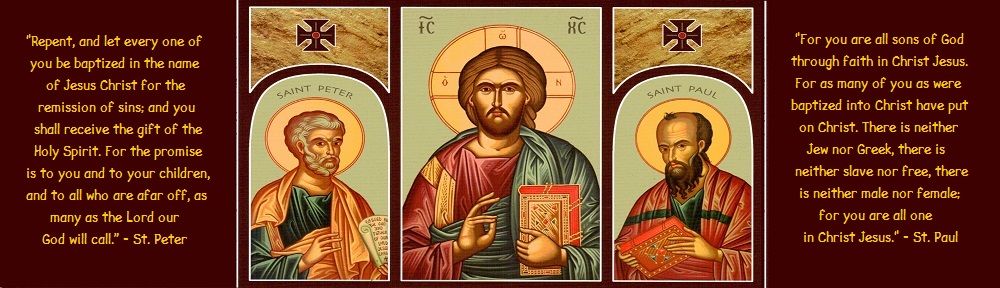
What does this wedding garment represent? Why is it so important for the guests to be wearing it, so important that, if they’re not wearing it, they don’t get to stay at the banquet, they get tossed out into the darkness? Well, remember, the king didn’t require good works of anyone in order for them to be invited to the feast. What is the thing He requires? St. Paul writes to the Galatians: For you are all sons of God through faith in Christ Jesus. For as many of you as were baptized into Christ have put on Christ. There is neither Jew nor Greek, there is neither slave nor free, there is neither male nor female; for you are all one in Christ Jesus. And if you are Christ’s, then you are Abraham’s seed, and heirs according to the promise.

See how St. Paul ties together faith and baptism. You are sons of God through faith in Christ Jesus. You put on Christ when you were baptized into Christ. You were clothed with the robe of Christ and His perfect righteousness through Baptism, where God held it out to you, and through faith, where you, by God’s power, put it on. But faith can’t just be put on once and then you’re automatically wearing it for the rest of your life. Faith in Christ, trusting in Christ Jesus, is a continual thing. It has to be. Church membership without faith in Christ is worthless. Calling yourself a Christian without faith is dishonest. When the King comes in to inspect the guests, He will not ask who your pastor was, or which church you or your family belonged to, or how many offerings you gave. He will look to see if you’re still clinging to His beloved Son in faith. And where He doesn’t find that, a person won’t be allowed to stay.

But God will provide everything you need to sustain your faith! Faith still comes by hearing. He’ll keep sending out His ministers to preach His word and administer His Sacraments! He’ll keep calling you to repentance when you go astray, and He’ll keep forgiving you your sins when you repent. Because He wants you there, in His wedding hall. He wants you to be among His chosen people—which is not the physical nation of Israel, but the number of those who believe in Christ Jesus and thereby escape the condemnation that is coming on this wicked world.

Many are called, but few are chosen. That’s how Jesus summarizes the lesson in the parable of the wedding banquet. Many have heard the Gospel invitation, and God sincerely wants the many who hear to believe and be saved. He wanted it for the Old Testament Jews. He wants it for all who hear. But “the chosen people,” the elect, are those who actually enter into His Christian Church by holy Baptism and who remain true members of the Church by faith in Christ Jesus. That means that you, who believe in Jesus as the Christ, the Son of the Living God, are the chosen people of God. Now continue in that faith, wearing the robe of the righteousness of Christ every day. And, as those who already wear Christ by faith, do as St. Paul said to the Ephesian believers in today’s Epistle. Watch carefully how you walk, not as unwise, but as wise. Make the most of the time, because the days are evil. Therefore do not be unwise, but understand what the will of the Lord is. Do not be drunk with wine, which leads to reckless behavior, but be filled with the Spirit. Speak to one another with psalms and hymns and spiritual songs, singing and making music in your heart to the Lord. Give thanks always for all things to our God and Father in the name of our Lord Jesus Christ. Amen.


Source: Sermons

Identifying the Millennium, Part 2

Sermon
Download Sermon
Service
[vimeo 875822532 w=540 h=360]
Download Service Download Bulletin

Sermon for Midweek of Trinity 19

Revelation 20:1-10

As promised, we’re returning to Revelation 20 and the millennium, which we started to discuss last week. Let’s review a bit. In his vision, John sees an angel coming down from heaven, holding the keys to the abyss and a great chain, who bound the dragon for a thousand years. The angel represents the Lord Jesus who came down from heaven and bound the strong man, that is, the devil, so that the devil wasn’t free to prevent people from being rescued from his kingdom, so that the devil wasn’t able to “deceive the nations” for a “thousand years.” That figurative number, the “millennium,” represents the whole time the devil is bound, namely, the whole time the Gospel goes out into the world, when the nations are being brought to faith in Christ, when he isn’t given free rein to trap them under his spell of deception, as he was prior to the coming of Christ, when the Gospel wasn’t being preached to all nations.

It also represents the time when the “souls of those who were beheaded for their testimony of Christ” are reigning with Christ and serving as priests of God in heaven, for a thousand years. That’s happening right now! The saints, the souls of believers who are in heaven, even if they were brutally killed here on earth, are not dead. They are alive and reigning with Christ even now! So the millennium started with Christ’s first coming and will last until shortly before He comes again. It’s not literally a thousand years. It’s basically the whole time of the New Testament era, 10x10x10.

But toward the end of it, or at the end of it, the devil must be “released for a little while,” John says, allowed again to deceive the nations, allowed to suppress the preaching of the Gospel to some extent, allowed to fill the world with false teachings and dupe people into believing them, no matter how crazy they sound. How many people in the world don’t believe in millions-of-years evolution these days, even though the notion of life and complexity and order coming from lifelessness and chaos and disorder is really nonsensical? How many people are coming to believe, in droves, that men marrying men or women marrying women is normal and good, or that men can be women and vice versa, even though it’s openly absurd? How many have come to believe that it’s perfectly acceptable and even morally good to end the life of a child in her mother’s womb? These are just a few examples. While Christianity grew and flourished in the world, these insane ideas were overturned and held at bay. But now, as Christianity and the preaching of the Gospel diminish in the world, the nations are again allowed to be deceived, as a divine punishment against them, because they didn’t love the truth, even when they had it clearly presented to them.

We looked at that much last week. Now let’s go on a little further. Now when the thousand years have expired, Satan will be released from his prison—again, not like a jail cell so that he’s trapped and can’t move, but like a restraint so that his success at deceiving people is greatly reduced—will be released, and will go out to deceive the nations which are in the four corners of the earth, Gog and Magog, to gather them together to battle, whose number is as the sand of the sea.

The nations which are in the four corners of the earth, that is, all nations everywhere. The devil goes out to deceive them, to turn them away from the Gospel of truth, to turn them against the holy Christian Church. And he gathers them together for battle against the Church of God, and their numbers are vast, “as the sand of the sea.” The vast majority of the earth will be “gathered” against God’s holy Church, not gathered literally, as in, all nations showing up on some battlefield in some country somewhere, but “gathered” in one mind, with one purpose, to rid the world of Christians.

That doesn’t mean everyone else gets along with one another, or that there are no other wars. For example, in the war currently being waged by Hamas against the nation of Israel, it seems clear that Hamas is out for blood and eager to do violence, while the nation of Israel is not out for blood but is justly defending itself from violence. But that doesn’t put Hamas on the devil’s side and Israel on God’s side. It isn’t “evil vs. good,” as far as God is concerned. Most Palestinians reject Jesus as the Christ. Most Israelis reject Jesus as the Christ. So it’s really a more violent form of evil vs. a less violent form of evil. Neither side is good. Neither side is “God’s people.” So this isn’t the war John is talking about in his vision.

John tosses out a reference here to “Gog and Magog.” That sends us back to Ezekiel 38 and 39. That whole chapter is a cryptic prophecy about the end of the world, and it’s important we understand it a little bit. Ezekiel, like John, uses prophetic, figurative language. He gives the name “Gog” to a wicked ruler from the land of “Magog,” far to the north—a ruler who has gathered many nations together with him to fight against the people of Israel in the land of Israel. This is relevant to what people are claiming still today. They’ll try to apply Ezekiel’s prophecy literally to the land of Israel, and to the modern Jews as the people of Israel. They’ll try to figure out which “nation from the north” is going to have a battle in the land of Israel against the modern Israelis. The problem is, Ezekiel’s prophecy is figurative. He describes Gog’s armies as riding in on horses, with their swords, and shields, and bucklers, and bows and arrows. Hardly a literal reference to how any wars are fought these days. What Ezekiel describes is very similar to what John describes in Revelation—the nations being gathered for a great battle against the people of God. But the people of God are not those who reject Jesus as the Christ. The people of God are Christians, regardless of their bloodline. And the “land of Israel” and the “mountains of Israel” and the “city of God” in Ezekiel’s prophecy is the Holy Christian Church. And the restoration of Israel to its land is the promise of the new heavens and the new earth for the people of God in Christ that God will establish after the Day of Judgment comes, the home of righteousness, as Peter calls it.

The names “Gog and Magog” may also have a figurative meaning, both in Ezekiel and in Revelation. There’s a Hebrew word related to “Gog” that means “roof” or “covering” or “covered.” “Magog” would be “uncovering” or “uncovered.” That would fit well with what John has described so far in Revelation. There are the “uncovered” or “open” enemies of the Christian Church—those who openly speak against Christ and His Gospel and `His people. There are also “covered” or “covert” enemies of the Christian Church—those who may even call themselves Christians but are false Christians, who promote a false Christ, an Antichrist. Both enemies, covered and uncovered, will gather against the true Church for battle.

But, just as we’ve seen repeatedly in Revelation, the actual battle never takes place.

They went up on the breadth of the earth and surrounded the camp of the saints and the beloved city. And fire came down from God out of heaven and devoured them. The devil, who deceived them, was cast into the lake of fire and brimstone where the beast and the false prophet are. And they will be tormented day and night forever and ever.

And the message of Revelation shines through brightly and clearly: Christians will be targeted by the devil and by the unbelieving world throughout the New Testament period. The last times before Christ’s return will be especially difficult. The voice of the Gospel will be practically silenced. The vast majority of the world will be deceived. And the Church will appear to be vastly outnumbered by those who would destroy her. But God Himself will come to our aid. Jesus will return in glory. And the devil and his allies in the world will be punished and tormented forever and ever.

What does this mean for us? Notice, the Church isn’t called on to do battle against any of these enemies. The Church doesn’t take up arms or armor, except for the “full armor of God” that Paul speaks about in Ephesians 6: Take up the whole armor of God, that you may be able to withstand in the evil day, and having done all, to stand. Stand therefore, having girded your waist with truth, having put on the breastplate of righteousness,  and having shod your feet with the preparation of the gospel of peace; above all, taking the shield of faith with which you will be able to quench all the fiery darts of the wicked one. And take the helmet of salvation, and the sword of the Spirit, which is the word of God; praying always with all prayer and supplication in the Spirit, being watchful to this end with all perseverance and supplication for all the saints.

Do as St. Paul says. Take up that armor, whether we’re still in the millennium or in that last little while when the devil is released. And put your hope in God, and in the victory He has promised to the faithful—the victory depicted in Revelation 20. Amen.

Source: Sermons

This is how God forgives sins

Sermon

Download Sermon
Service
[vimeo 874584345 w=540 h=360]
Download Service Download Bulletin

Sermon for Trinity 19

Ephesians 4:22-28  +  Matthew 9:1-8

Last week we heard Jesus’ answer to the question about the greatest commandment in the Law: You shall love the Lord with all your heart, and you shall love your neighbor as yourself. But, as we discussed, the greatest commandment is still not the greatest teaching in the Bible. The greatest teaching is the Gospel: how Jesus, the Christ, by His perfect life and by His innocent death on the cross, earned the forgiveness of sins for all who have broken the greatest commandments, and how the Lord now promises to forgive sins to all who believe in Jesus. We see a brilliant example of the forgiveness of sins taking place in today’s Gospel—what it is, how it takes place, and who has the authority to forgive.

We’re told that Jesus came to His own city. Now, we think first of Nazareth, where Jesus grew up. He’s known, after all, as Jesus of Nazareth. But, as Mark and Luke make clear, “His own city” is no longer Nazareth. It’s now Capernaum. Because not too long before this, the people of Nazareth, Jesus’ hometown, tried to kill Him, tried to throw Him right over a cliff. But Jesus is more than welcome in Capernaum. So welcome, in fact, that the people crowded into the house where He was teaching, crowded in so tightly that there was standing room only. That made it impossible for the four men carrying the stretcher with the paralytic on it to get in to see Jesus. So they climbed up on the roof of the house, hoisted the stretcher up to the roof, dug a hole through the roof, and lowered the paralyzed man down through the hole in the roof to where Jesus was.

What an amazing scene that must have been! But Matthew doesn’t bother with those details that Mark and Luke record. The way they entered Jesus’ presence wasn’t the important part of the story. What happened next was.

When he saw their faith, Jesus said to the paralytic, “Take heart, son! Your sins are forgiven you.”

You heard those same words this morning after you confessed your sins and your faith in Christ Jesus. Let’s take a step back and look at what it means to forgive sins.

There is such a thing as personal forgiveness. When someone hurts you in some way, you either hold it against them, so that your relationship with them remains fractured, or you forgive them and your relationship is repaired, although some consequences of the sin may remain.

That’s not what Jesus was doing in today’s Gospel, offering personal forgiveness. The paralytic hadn’t sinned against Jesus personally, not against Jesus the man. He had sinned against God directly, as all people have, and he had surely also sinned against other people, which is also a sin against God. He, like everyone else, had broken the greatest commandments in the Law, and, as a sinner, he deserved to remain separated from God for eternity. He deserved to die.

But Jesus takes all the man’s sins committed against God and against other men, lumps them all together, and simply says, “Take heart, son! Your sins are forgiven you!” Or, in other words, “You’re forgiven for all the wrongs that you’ve done!”

What does that mean, “You’re forgiven”? It means, God will not hold your sins against you anymore. God, the holy Judge, hereby releases you from your guilt and from the punishment you deserve for your sins. You are no longer condemned. You are no longer a subject of the devil’s kingdom. You are no longer going to hell. No, you are justified before God. You are declared righteous in God’s courtroom. You are now a subject of God’s kingdom, a beloved child of the heavenly Father, a member of Christ, an heir of eternal life. All of that is included in the statement, “Your sins are forgiven you.”

Are there any conditions given for this forgiveness? Not a condition, as in, “You have to do something first to earn it!” No, there’s a reason why the Holy Spirit sets a paralytic before us as a prime candidate for receiving the forgiveness of sins. Like paralytics, we are unable to move, unable to earn the forgiveness of sins. But there is a condition, or a component, or an ingredient that does have to be there. All three Gospel writers give us this key detail: When Jesus saw their faith. The Holy Spirit had all three Evangelists record this event and this specific part of the event, because it’s important. When we’re talking about forgiving sins, faith is an essential part of it.

And what is faith? It’s the confidence of the heart that Jesus is good and merciful, willing and able to help, and always faithful to His Word and promise. And faith isn’t our work or our contribution to our forgiveness. It’s simply the thing that has to be there, and it’s worked by God the Holy Spirit through the preaching of the word of Christ. This is why it’s stated so clearly in Scripture that a person is justified before God by faith in Christ Jesus and not by any works of the Law.

That’s so different from what the world thinks is the path to God. Just do your best. Just be a better person today than you were yesterday, and you’ll be fine. Just love everyone. I assure you, that is what the unbelievers in your life think. They probably even think that’s what the Christian faith is all about. So why bother being a Christian? Just be a good person, and you’ll be fine. But you have to tell them the truth. If they would really please God by doing good things, then they’d have to be a whole lot better than they are now. Impossibly better. No, it’s not a person’s record of being good enough that will ever get them to be accepted by God. It’s only faith in Christ Jesus.

And contrition necessarily comes before faith. What does a person have faith in Jesus for or to do? For the forgiveness of sins. That implies that you acknowledge you have sins to forgive. If you want God’s acceptance through faith in Christ, that means you acknowledge you’re not acceptable as you are. And if you want your sins forgiven, that implies that you no longer want to cling to them or defend them or think fondly of them. “Oh, I know that was wrong, but it was no big deal, or it was so much fun!” There can be no faith in Christ for forgiveness if you don’t hate your sin, if you don’t really want that sin to be erased from your past. But where there is contrition, where you yearn for a clean slate, and where you look to Christ in faith for that cleansing, there God is willing and eager to forgive, as Jesus did for the paralytic in our Gospel.

That leads to the other key question. Who has authority to forgive sins—to change a person’s status before God from condemned sinner to forgiven child of God?

Some of the scribes and Pharisees who were crowded into that house in Capernaum raised that issue among themselves. As Luke tells us, they were thinking to themselves, “Who can forgive sins but God alone?” They were exactly right about that. Only God can change a person’s status before God. What they didn’t account for was that God was standing right there in front of them. Yes, Jesus even knew their thoughts, which only God can know. And to prove His divine authority to forgive sins, Jesus asked them, Is it easier, to say, ‘Your sins are forgiven you,’ or to say, ‘Arise and walk’? But that you may know that the Son of Man has authority on earth to forgive sins”—then he said to the paralytic, “Arise, take up your bed, and go to your house.” And he did, proving that Jesus, the Son of Man had authority on earth to forgive sins.

Jesus spoke of His authority in other places. The Father has entrusted all judgment to the Son. All authority in heaven and on earth has been given to Me. All judgment. All authority. The right to grant life as He pleases, or to hold people’s sins against them. That’s why forgiveness apart from Jesus is impossible, just as forgiveness apart from faith in Jesus is impossible. He and He alone has the authority to forgive sins.

But, if all authority and all judgment has been entrusted to Jesus by God the Father, then doesn’t that mean the same Jesus has the right to share some of that authority with others, if He chooses? And He has chosen!

The text before us is actually a perfect example of what Paul wrote to the Corinthians in 2 Cor. 5: God was in Christ, reconciling the world to Himself, not counting men’s sins against them. Now, reconciling the world to Himself doesn’t mean reconciling or forgiving the sins of everyone in the world—or everyone in the room. That’s not what Jesus did in today’s Gospel. But one by one, as the word about Christ brought people to faith, He reconciled them to God through faith. He forgave them their sins.

But then Paul goes on, and God has committed to us the word of reconciliation. Now then, we are ambassadors for Christ, as though God were pleading through us: we implore you on Christ’s behalf, be reconciled to God. For He made Him who knew no sin to be sin for us, that we might become the righteousness of God in Him. Just as God was in Christ, reconciling the world to Himself, so He has appointed ministers, who are Christ’s divine ambassadors to call sinners to repentance and faith in Christ Jesus, and to forgive the penitent and believing.

So Jesus said to His apostles, I will give you the keys of the kingdom of heaven, and whatever you bind on earth will be bound in heaven, and whatever you loose on earth will be loosed in heaven. And again after His resurrection, Receive the Holy Spirit. If you forgive the sins of any, they are forgiven them; if you retain the sins of any, they are retained.”

And so ministers are set in place around the world by Jesus to keep carrying out this ministry of reconciliation, to keep reconciling sinners to God, first by preaching the Law to those who need to hear it, who are secure in their sins at the moment; then by preaching about Jesus, who offered Himself as the atoning sacrifice for the sins of the world; and then by acting in Jesus name to forgive sins to those who have faith in Jesus. We can’t “see” faith, as Jesus could, so we are left to rely on a person’s confession of faith. We practiced it again here this morning in a general way. But private confession is also available, if you wish to be reexamined according to God’s Word, have your personal confession of faith heard, and have the absolution pronounced on you directly.

Now, the Christian life doesn’t end there, receiving the forgiveness of sins from Jesus through His appointed ministers. The paralytic was healed. Then what? He got up and walked. Well, St. Paul, in today’s Epistle, touched on the “Now what?” of the Christian life. Now that you’re forgiven, now that you’ve put on the New Man and put off the Old, you get up and walk according to the New Man. Live like forgiven children of God, not like unbelieving children of the devil. You wanted forgiveness for the deeds of the Old Man, right? So why would you continue to live in those deeds? Why wouldn’t you strive to get rid of them, if you wanted forgiveness for them?

There’s much more we could say about that, but we’ll leave it for another sermon, because today’s Gospel gives us enough to think about for the moment. The Christian faith centers around Christ and the forgiveness that He earned for us on the cross and offers to us in the Word and in the Sacraments. So use the ministry of the Word that Christ has instituted! Live in repentance! Believe the Gospel! And then know that the words of Christ always apply to you: Take heart, son, daughter! Your sins are forgiven you! Amen.

Source: Sermons